• Tag Archives: all about John F. Kennedy

    The Civil Rights Movement

    John F. Kennedy took office 100 years after the beginning of the Civil War. Slavery had been illegal for many years, but racism and discrimination persisted. In the South, black and white people couldn’t share the same restaurants, buses, or schools. Throughout the country, black people didn’t have the same opportunities as whites.
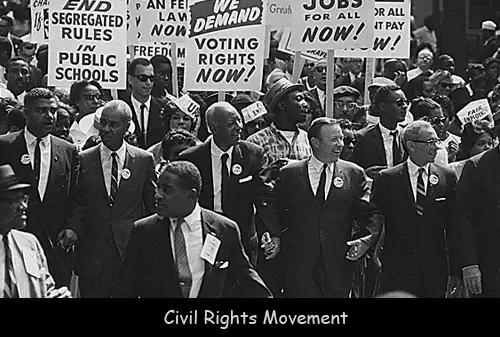
    John F. Kennedy wanted to change that. At the same time, many blacks quietly began protesting for better treatment. Among them was a man named Martin Luther King, Jr. The Civil Rights movement was gaining momentum.

    Fun Facts:

    • In 1954, the Supreme Court ruled that schools could not segregate black children and white children. All children deserved the same opportunity for a quality education. In the Deep South, people were angry about this. They wanted to keep the children separate. You can read more about this in the picture book, The Story of Ruby Bridges, by Robert Coles and George Ford.
    • In 1955, Rosa Parks was arrested for refusing to give up her seat on a bus to a white person. Other African-Americans refused to ride the buses, boycotting them, in response to Parks’ arrest. In 1956, the Supreme Court said that segregated buses were unconstitutional.
    • During 1960, black college students refused to leave a lunch counter even though they had been denied service. Other students began doing the same thing. This was called a sit-in. Many restaurants and lunch counters changed their policies as a result.
    • Martin Luther King led a group of protesters to peacefully protest in Birmingham, Alabama. The police there attacked the protesters with dogs and fire hoses. Many of the protesters were taken to jail and King’s hotel and his brother’s house were bombed. President Kennedy sent troops into the city to restore peace. City leaders agreed to give blacks more rights.
    • Throughout the South, protesters marched during the early 1960s. By 1963, about 14,000 demonstrators had been arrested.
    • On June 11, 1963, President Kennedy announced a bill that would make it illegal to discriminate against someone because of his or her race. President Johnson, who took Kennedy’s place, pushed the bill through Congress.

    Vocabulary:

    1. Racism: an attitude of hating or disrespecting someone because of his race or skin color
    2. Segregate: to keep separate
    3. Boycott: to formally refuse to use or participate in something

    Questions and Answers:

    Question: Did discrimination end with the Civil Rights Act of 1964?

    Answer: No. Only three weeks after Martin Luther King led a peaceful march to Washington D.C., a bomb exploded in a church in Birmingham, killing for girls. Twenty other people were injured. Racial relationships are still complicated sometimes.

    Learn More

    Watch a video of Martin Luther King, Jr. giving his famous “I Have a Dream” speech.
    John F. Kennedy’s Legacy

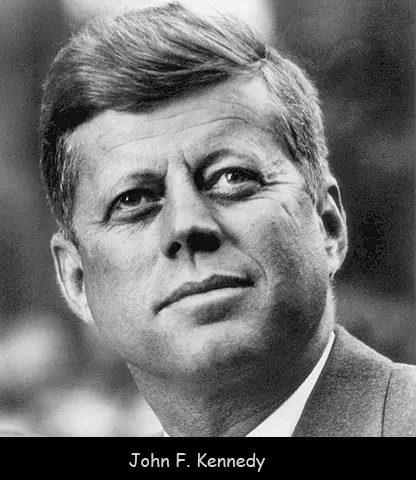
    John F. Kennedy won the 1960 presidential election against Republican candidate, Richard M. Nixon. Kennedy was young, energetic, and handsome. He spoke of the 1960s as a “New Frontier,” and encouraged Americans to be pioneers. He said, “Ask not what your country can do for you, but what you can do for your country.” Americans were inspired by his patriotism and his energy. Unfortunately, his time as president was short-lived. He was assassinated on November 22, 1963. Americans were shocked and stunned by his death.

    Fun Facts:

    • John F. Kennedy urged Americans to work harder against “the common enemies of man…tyranny, poverty, disease and war itself.”
    • Kennedy helped establish the Peace Corps in 1961. Americans can volunteer to spend two years abroad helping people in impoverished conditions.
    • Kennedy’s wife, Jackie, was hugely popular for her grace, intelligence, and beauty. She renovated the White House, adding both modern conveniences and an appreciation for its history. Along with Kennedy, she helped establish positive diplomatic relations with leaders in other countries.
    • During Kennedy’s presidency, he dealt with a contentious relationship with the Soviet Union. During this time, the Soviet Union built a wall between East and West Germany to prevent East Germans from escaping Communist rule. Kennedy promised to keep the city of West Berlin free.
    • In October, 1962, Kennedy learned that the Soviets had placed missiles in Cuba, near the American coastline. His advisors suggested an air strike and ground invasion of Cuba. Kennedy feared this approach would start a nuclear war. Instead, he ordered an American fleet of 18 ships to remain in the Atlantic Ocean near Cuba. These ships would bar Soviet ships headed to Cuba. For several days, the world wondered whether Soviet leader, Khrushchev, would back down. Finally, Khrushchev turned his ships around and removed the missiles. War was avoided.
    • In November, 1963, Kennedy went to Dallas, Texas to discuss his ideas about civil rights with Democrats there. As he and his wife drove in a motorcade, he was shot in the head by Lee Harvey Oswald. Kennedy died within the hour.

    Vocabulary:

    1. Tyranny: when a leader rules with force and cruelty
    2. Diplomatic relations: relations between leaders of countries
    3. Motorcade: a line of cars that transports important leaders, their advisors, and security team

    Questions and Answers:

    Question: What Happened to Lee Harvey Oswald?

    Answer: Lee Harvey Oswald was shot and killed by Jack Ruby, a nightclub owner, as police led him out of a jail in Dallas.

    Learn More

    Visit the JFK library to see a short picture book about John F. Kennedy.

    Lyndon B. Johnson Leads the Country after Kennedy’s Death

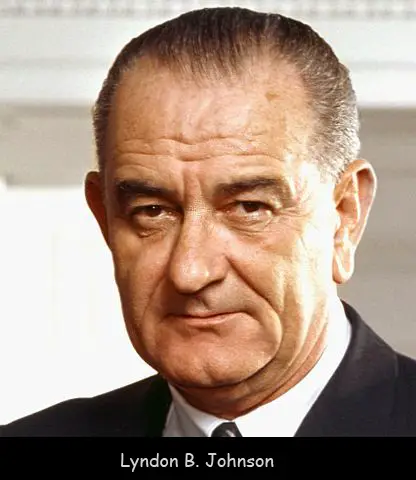
    Vice President Lyndon B. Johnson became president after President John F. Kennedy was assassinated. Johnson was in Dallas with Kennedy when he was shot. He boarded Air Force One with Mrs. Kennedy and took the presidential oath of office right there on the plane. Mrs. Kennedy was still wearing her blood-stained suit. Johnson’s voice trembled as he repeated the oath. He knew the American people were scared and he knew he had a big job to do. As president, he continued many of Kennedy’s plans and added some of his own.

    Fun Facts

    • Lyndon B. Johnson grew up in rural Texas. His family was poor. He became a school teacher and congressman before he became president.
    • Johnson read a book called The Other America by Michael Harrington, which described the lives of poor people living in America. Johnson was inspired to try to help these people.
    • He declared a War on Poverty and passed the Economic Opportunity Act of 1964, which offered job training, service opportunities, and a domestic Peace Corps. The Office of Economic Opportunity had a $1 billion budget and was aimed at stopping poverty.
    • Johnson, along with his wife, “Lady Bird” Johnson, launched Head Start, a preschool program designed to prepare children for kindergarten.
    • In 1964, Johnson ran for presidential office again. He envisioned a “Great Society” that would end “poverty and racial injustice” and create “abundance and liberty for all.” He easily defeated Republican candidate, Barry Goldwater.
    • Not everyone agreed with Johnson’s huge reforms. Conservatives were concerned that his programs created a big federal government. They wondered who would pay for his expensive programs. They also worried that the programs would ultimately be ineffective.

    Vocabulary

    1. Domestic: at home or in one’s own country
    2. Envision: to see, plan, or have a vision
    3. Abundance: plenty

    Questions and Answers

    Question: Did Lyndon B. Johnson’s plans work?

    Answer: Johnson had a rugged confidence that restored the American people’s faith in government after Kennedy’s death. His programs have had mixed results. They probably have helped some people, but poverty continues to be a problem in the U.S. His programs paved the way for bigger federal government – and a bigger federal budget and deficit. The Warren Court, the Supreme Court during the 1960s, made several rulings that changed life in America. For example, one case outlawed prayer in public schools.

    Learn More

    Visit Scholastic to learn more about Lyndon B. Johnson.