
• Tag Archives: Fatcs for kids about Pilgrims

    The First Thanksgiving

    When the Pilgrims arrived at Plymouth in November of 1620, they faced several months of work and hunger. During that winter, they lived on the Mayflower, which was anchored a mile or two out in  Plymouth Harbor. The men rowed inland in small boats every day to build houses, returning in the evening to sleep. Many of the Pilgrims became sick during this cold, long winter. In fact, half the group died.

    Squanto, a Wampanoag Indian, befriended the Pilgrims. He, along with other Wampanoag, taught the Pilgrims how to grow corn and other foods. Without the Wampanoags’ help, the Pilgrims probably wouldn’t have survived. By the following autumn, the Pilgrims had built seven houses, three storehouses for food, and a meeting house. They were very grateful for their successes. They held a feast with the Wampanoags to thank them and to thank God.
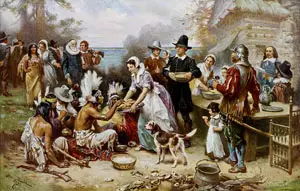
    Fun facts of Pilgrims- Image of The First Thanksgiving
    Fun facts of Pilgrims- Image of The First Thanksgiving

    Fun Facts

    • The Pilgrims often had days for giving thanks. These days were usually spent fasting and praying, not feasting.
    • The first Thanksgiving feast was held in early autumn of 1621, after the first harvest.
    • We’re not sure if wild turkey was on the first Thanksgiving menu. Duck was probably more likely.
    • Pilgrim women roasted the ducks over a fire. The feast also probably included stewed pumpkin and samp, a porridge made from ground corn.
    • Massasoit, king of the Wampanoag people, was cautiously friendly toward the Pilgrims. He gave them help and ensured their safety. He and his men were honored guests at the feast. The Wampanoags brought deer, or venison, to the meal.
    • The first Thanksgiving was not one meal. Feasting lasted for about a week.
    • The children played games, such as Blind Man’s Bluff. Both Wampanoag and Pilgrim children played with dolls and balls.
    • Adult men enjoyed shooting games. 

    Vocabulary

    1. Anchor: to secure a ship at sea or resting in a harbor
    2. Fast: to go without food or water, usually as a sign of religious devotion
    3. Venison: deer meat

    Frequently Asked Questions

    Question: Has America always celebrated Thanksgiving?

    Answer: George Washington and a few other leaders called for a day of Thanksgiving, but it did not become a national holiday until 1863. During the Civil War, President Abraham Lincoln called for a national observance of Thanksgiving. He said, “I do therefore invite my fellow citizens in every part of the United States, and also those who are at sea and those who are sojourning in foreign lands, to set apart and observe the last Thursday of November next, as a day of Thanksgiving and Praise to our beneficent Father who dwelleth in the Heavens.”

    Learn More

    Visit Scholastic to learn more about the First Thanksgiving.

    Read Abraham Lincoln’s Thanksgiving Proclamation.
    Profile: William Bradford

    “Out of small beginnings have greater things been produced by His (God’s) hand that made all things of nothing, and gives being to all things that are are; and as one small candle may light a thousand, so the light here kindled has shone unto many.”

    Many of the early European visitors to North America came seeking their fortunes. Trappers earned money selling furs; conquistadors came looking for gold. The early Pilgrims had only one goal: they wanted to worship God as they saw fit. They wanted to pray and read the Bible together without persecution. They believed that both the Catholic Church and the Church of England had become corrupted by greedy leaders. They wanted to start a new religion.

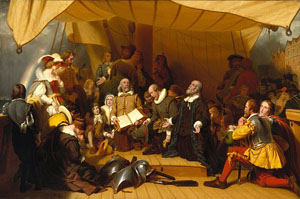
    William Bradford joined this group, known as the Separatists, at the age of 18, against his family’s wishes. He and the other church members were persecuted in England. They found some peace in Holland but dreamed of starting their own settlement, with their own culture and religion. At the age of 30, Bradford sold everything he had and sailed for North America on the Mayflower. He became the governor of Plymouth, the new colony in America, and served in this position for more than 30 years. 

    Fun facts of William Bradford- Image of Embarkation Pilgrims
    Fun facts of William Bradford- Image of Embarkation Pilgrims

    Fun Facts

    • William Bradford was born in Yorkshire in 1590. His father died when he was a baby. His mother and grandparents died when he was a small child. William was an orphan at the age of seven.
    • He and his sister, Alice, were raised by their uncle, Robert Bradford.
    • Bradford was a sickly child and enjoyed reading the Bible to pass the time. He learned about the Separatist church during his teenage years and soon converted.
    • He married Dorothy May in Holland and they had one child.
    • Knowing how hard the journey would be, William and Dorothy left their child with friends when they sailed on the Mayflower. Dorothy fell off the ship and drowned as it sat in the port at Cape Cod.
    • William must have been very sad, but he quickly got to work in Plymouth, encouraging the other colonists to build homes.
    • Bradford was made governor of the Plymouth Colony after John Carver’s death. He tried hard to be fair and make good decisions for the colony. He helped establish peaceful relationships with the Indians.
    • Bradford kept detailed journals of the Plymouth Colony. These journals are the main source of information we have about the people. The journals have been published as a book, History of Plymouth Plantation.
    • William Bradford married widow, Alice Carpenter Southworth in 1623. They had three children.
    • Bradford became ill during the winter of 1657. He died that May at age 68. He had devoted his life to building the Plymouth Colony.

    Vocabulary

    1. Persecution:  to be emotionally or physically harmed because of one’s beliefs
    2. Orphan:  one whose parents have died

    Questions and Answers

    Question: What jobs did Bradford do in his role as governor?

    Answer: He was a very busy man. He oversaw the courts, kept the finances, communicated with investors, and negotiated relationships with the Indians.

    Learn More

    Visit Scholastic to learn more about William Bradford.
