• Tag Archives: About Thomas Jefferson

    The Lewis and Clark Expedition

    Thomas Jefferson was interested in learning more about the country west of the Mississippi River. In 1803, he persuaded Congress to pay for an expedition to explore this land. In May 1804, Meriwether Lewis and William Clark, both army officers, set out on their expedition. Their journey took more than two years, but paved the way for western settlement.
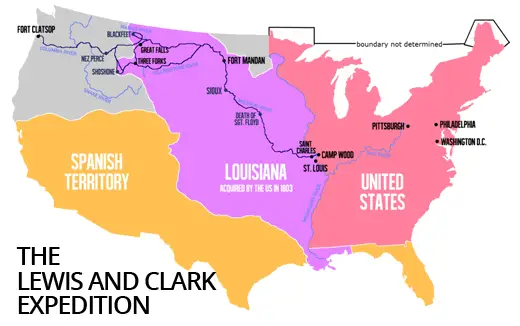
    The Lewis and Clark Expedition

    Fun Facts

    • Lewis and Clark departed from St. Louis, rowing up the Missouri River. They spent a winter in a Mandan Indian trading village. They rode horses over the Rocky Mountains through Wyoming, Idaho, and Oregon to the Pacific Ocean – a roundtrip journey of over 8,000 miles.
    • Jefferson asked Lewis and Clark to map the region. He hoped that they would find a river running from the Missouri to the Pacific Ocean, which people could travel on. He also asked them to study and collect natural resources, including rocks, plants, and animals. He wanted them to befriend the native tribes and learn about their languages and customs.
    • Lewis and Clark took six months to prepare for their journey, gathering supplies and recruiting the 31 men who would accompany them. It was hard to know exactly what to take since no one had ever explored the area before.
    • At the time, Europeans had only explored as far as the Missouri River. A few had also ventured along the Columbia River into what is now central Oregon. Thomas Jefferson thought Lewis and Clark might find wooly mammoths and active volcanoes. Instead, they found 300 plant and animal species unknown to science at the time; 50 Indian tribes; and the massive, rugged Rocky Mountains.
    • After arriving at the Pacific Ocean, Lewis and Clark built Fort Clatsop and spent the winter in present-day Oregon. They split up on their return to the East so that they could explore more land. Lewis and his men were attacked by Blackfoot Indians trying to steal from them. Two Indians were killed. Lewis was later shot in the leg by one of his own men.
    • The group were given a hero’s welcome when they returned to Washington D.C. Lewis was given 1,600 acres of land, a generous salary, and the role of governor of the Louisiana Territory.

    Vocabulary

    1. Recruit: seek out, enlist
    2. Venture: explore

    Questions and Answers

    Question: Did any women join the expedition?

    Answer: Sacagawea, a Shoshone Indian was the only woman to go on the expedition. She played a vital role in finding food, navigating rough terrain, and negotiating with the native tribes.

    Learn More

    Visit Scholastic to play an interactive game and pretend you’re on the Lewis and Clark Expedition.

    Read More About The Lewis and Clark Expedition
    The Declaration of Independence

    We hold these Truths to be self-evident, that all Men are created equal, that they are endowed by their Creator with certain unalienable Rights, that among these are Life, Liberty, and the Pursuit of Happiness.”

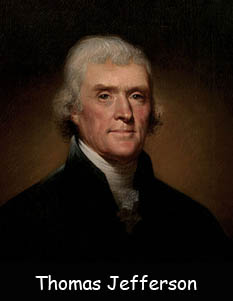
    The colonists’ original goal in fighting the British was to gain more freedom, while still remaining loyal to the Crown. By the spring of 1776, most of them believed they needed to be independent of Great Britain. In June of 1776, the Continental Congress selected a committee of five men to write an official declaration of independence. Thomas Jefferson was chosen to draft this historic document, which was approved by the Continental Congress on July 4, 1776.

    Facts about Declaration of Independence- Image of Thomas Jefferson
    Facts about Declaration of Independence- Image of Thomas Jefferson

    Fun Facts

    • The committee of men who drafted the Declaration of Independence knew that they were committing treason and could be executed for their crimes.

    • Thomas Jefferson was very well-educated. He was a gifted writer, as well as a scientist, inventor, lawyer, architect, and musician. He knew about Greek and Roman history and had studied the writings of men, such as John Locke.

    • John Locke believed that government is a contract between leaders and people. If the government wasn’t working, the people had the right to choose a new government. Jefferson believed in these ideals.

    • Jefferson was troubled by slavery, but didn’t know how to find a solution for it. He even kept slaves himself. In the Declaration of Independence, he wrote a list of complaints against the King, including his belief that the King made slavery possible. The Continental Congress removed that line.

    • John Hanco-ck, President of the Continental Congress, signed his name first. His is also the largest signature, supposedly because he wanted King George to be able to read Hanco-ck’s name without his glasses.

    • The Declaration of Independence was written on parchment with iron gall ink. The Founding Fathers were somewhat careless with it, rolling it up and carrying it with them from place to place. Today, it is displayed in a bullet-proof case filled with argon gas to preserve it.

    • The Declaration of Independence has inspired people worldwide to view themselves and the role of government in a new way. This document gives people hope and dignity.

    Vocabulary

    1. Draft: to write

    2. Execute: to intentionally kill someone as a punishment

    3. Dignity: self-respect

    Questions and Answers

    Question: Did the Declaration of Independence give equal rights to everyone?

    Answer: Although the Declaration of Independence declares that all “men are created equal,” they were not all given equal rights. Black men, poor men, and all women were denied the right to vote. Only educated men with some wealth could choose leaders. The Founding Fathers believed that poor men could too easily be bribed or persuaded by wealthy men. Do you think this was fair? Why or why not?

    Learn More

    Visit the History Place to see a photo of the original draft and hear an audio version of the Declaration of Independence.

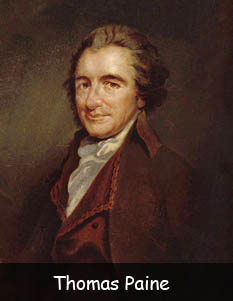
    Thomas Paine

    You’ve probably heard of Thomas Jefferson, Samuel Adams, John Hanco-ck, and George Washington – all men who played a vital role in the Revolutionary War, but what about Thomas Paine? Most of the Founding Fathers were highly educated, wealthy men who held prominent positions. Thomas Paine was a man of the people. His fiery pamphlet, Common Sense, inspired people everywhere to fight for the cause of liberty.

    Image of Thomas Paine
    Image of Thomas Paine

    Fun Facts

    • Thomas Paine was born in England in 1737. He failed in school and later became a tax collector. He was fired twice from this job. He came to America in 1774 and studied journalism.

    • Paine joined the Continental Army, but wasn’t a very successful soldier. Then he wrote a short political pamphlet, Common Sense, which urged Americans to seek freedom from Great Britain.

    • Paine’s writing was simple and easy to understand. Americans hadn’t been thinking about independence from Great Britain, but Paine’s writing inspired them. More than 150,000 copies were sold in just a few months.

    • George Washington used Paine’s words to rally troops. He said, “These are the times that try men’s souls. Tyranny, like Hell, is not easily conquered; yet we have this consolation with us, that the harder the conflict, the more glorious the triumph.”

    • Thomas Paine played a vital role in the American Revolution, but his later writing angered people and made them forget the good work he had done during the Revolutionary War.

    • Paine wrote papers against organized religion, which made him very unpopular. He was thrown in prison and almost executed in France for his political views during the French Revolution.

    • Paine died in 1809. Only six people attended his funeral.

    Vocabulary

    1. Prominent: important, visible

    2. Pamphlet: a short booklet or paper containing only a few pages

    3. Unpopular: disliked by most people

    Questions and Answers

    Question: Did anyone else encourage the colonists to seek independence from Great Britain?

    Answer: Samuel Adams had been urging Congress to seek independence for several months, but he wasn’t as skilled at reaching the common people.

    Learn More

    Visit Scholastic to learn more about Thomas Paine.