• Tag Archives: Great Britain

    Early American Literature and Art

    Art and literature had flourished in Europe for centuries. Although many early American settlers were well-read and educated, most writings were personal journals or political essays. Folk art, including signs, flags, and quilts were common. America began to develop its own literary and artistic voice in the early-to-mid 1800s.
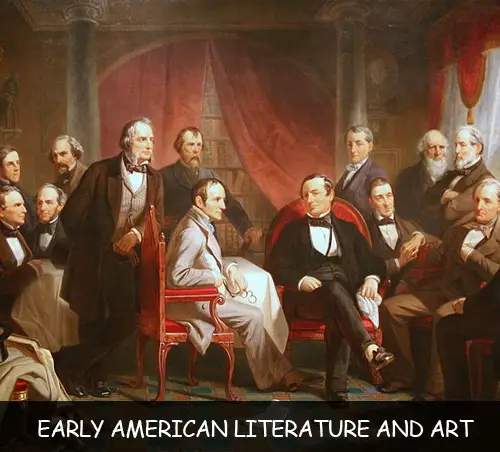
    Early-American-Literature-and-Art

    Fun Facts

    • Idealism flourished in the early 1800s. Several groups, such as the Transcendalists in Massachusetts, formed. Out of these groups came great poets and writers, such as Robert Browning Jr., Emily Dickinson, Henry David Thoreau, and Louisa May Alcott.
    • People wanted a language and writing style that was distinctly American, different from Great Britain. Noah Webster published Webster’s American Dictionary of the English Language in 1828. Previously, words’ pronunciations and spellings differed from area to area. In other words, people made up words and wrote them however they liked. Webster’s dictionary made American-English more consistent, as well as unique from Great Britain.
    • In a time before photographs, people loved to have their portraits painted by folk artists.
    • Young girls spent hours stitching samplers, which featured scriptures, quotes, or even the alphabet.
    • Furniture was often painted with elaborate designs. The wealthy had murals painted on the walls of their homes. The murals depicted landscapes or even historical events.
    • Irving Washington was one of the first American fiction writers to gain fame and earn a living through writing. He wrote The Legend of Sleepy Hollow and Rip Van Winkle.

    Vocabulary

    1. Idealism: a philosophy of striving for a more perfect environment and world
    2. Transcendentalism: a spiritual philosophy of seeing God in everything and believing in the divine potential of humans
    3. Pronunciation: how words are said

    Learn More

    Visit the Metropolitan Museum to learn more about American folk art.
    Britain’s Allies

    Not everyone was happy when America won its independence from Great Britain. Many people, particularly wealthy slave-owners in the southern states, remained sympathetic to Great Britain. These people were known as Loyalists or Tories. Many black slaves and Native Americans fought for the British, as well.

    Image for Britain’s Allies
    Fun Facts for Britain – Image for Britain’s Allies

    Fun Facts

    • About one-fifth of the colonists were Loyalists. These included government leaders, such as Governor Thomas Hutchinson and many pastors and priests of the Church of England.

    • Another one-third of the colonists remained neutral during the war, refusing to take sides.

    • The Loyalists were hated by the colonists and sometimes experienced mob violence. Over 80,000 Loyalists fled, mostly to Canada.

    • Benedict Arnold was a brilliant American war hero. Unfortunately, his pride got the better of him. He felt that Congress had failed to appreciate him and made a deal with General Burgoyne to sell the fort, West Point, to the British. The plot was discovered and Arnold was branded a traitor to America. He became a British general, but the British never really trusted him.

    • Native Americans believed that if the Americans won, they would lose more of their rights and their land, which was true. Many tribes, such as the Cherokee tribe, fought against the Patriots. After the war, all tribes – even those who had fought with the colonists – were displaced from their land and forced further west.

    • The Declaration of Independence made no mention of freedom for slaves. During the war, the governor of Virginia declared freedom for any slave who would fight for the British. More than 800 slaves took up arms against the colonists and more than 50,000 slaves fled from their owners.

    Vocabulary

    1. Neutral: to remain without a position or opinion

    2. Traitor: one who betrays his country or friends

    3. Displace: to uproot

    Questions and Answers

    Question: Were the Loyalists outspoken about their opinions?

    Answer: Some were, especially in the beginning, but many people on both sides quietly supported their causes. Some acted as spies. Those with money offered financial support.

    Learn More

    Visit PBS to play a game, “The Road to Revolution.”

    The Declaration of Independence

    We hold these Truths to be self-evident, that all Men are created equal, that they are endowed by their Creator with certain unalienable Rights, that among these are Life, Liberty, and the Pursuit of Happiness.”

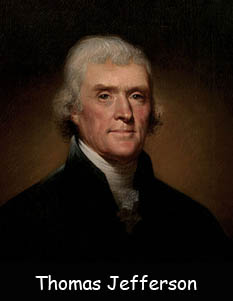
    The colonists’ original goal in fighting the British was to gain more freedom, while still remaining loyal to the Crown. By the spring of 1776, most of them believed they needed to be independent of Great Britain. In June of 1776, the Continental Congress selected a committee of five men to write an official declaration of independence. Thomas Jefferson was chosen to draft this historic document, which was approved by the Continental Congress on July 4, 1776.

    Facts about Declaration of Independence- Image of Thomas Jefferson
    Facts about Declaration of Independence- Image of Thomas Jefferson

    Fun Facts

    • The committee of men who drafted the Declaration of Independence knew that they were committing treason and could be executed for their crimes.

    • Thomas Jefferson was very well-educated. He was a gifted writer, as well as a scientist, inventor, lawyer, architect, and musician. He knew about Greek and Roman history and had studied the writings of men, such as John Locke.

    • John Locke believed that government is a contract between leaders and people. If the government wasn’t working, the people had the right to choose a new government. Jefferson believed in these ideals.

    • Jefferson was troubled by slavery, but didn’t know how to find a solution for it. He even kept slaves himself. In the Declaration of Independence, he wrote a list of complaints against the King, including his belief that the King made slavery possible. The Continental Congress removed that line.

    • John Hanco-ck, President of the Continental Congress, signed his name first. His is also the largest signature, supposedly because he wanted King George to be able to read Hanco-ck’s name without his glasses.

    • The Declaration of Independence was written on parchment with iron gall ink. The Founding Fathers were somewhat careless with it, rolling it up and carrying it with them from place to place. Today, it is displayed in a bullet-proof case filled with argon gas to preserve it.

    • The Declaration of Independence has inspired people worldwide to view themselves and the role of government in a new way. This document gives people hope and dignity.

    Vocabulary

    1. Draft: to write

    2. Execute: to intentionally kill someone as a punishment

    3. Dignity: self-respect

    Questions and Answers

    Question: Did the Declaration of Independence give equal rights to everyone?

    Answer: Although the Declaration of Independence declares that all “men are created equal,” they were not all given equal rights. Black men, poor men, and all women were denied the right to vote. Only educated men with some wealth could choose leaders. The Founding Fathers believed that poor men could too easily be bribed or persuaded by wealthy men. Do you think this was fair? Why or why not?

    Learn More

    Visit the History Place to see a photo of the original draft and hear an audio version of the Declaration of Independence.

    The Rise of Slavery

    Plantation owners in Virginia and other Southern states originally used indentured servants to work in the fields. After Bacon’s Uprising, plantation owners realized that freed indentured servants posed a risk. They began importing slaves from Africa to work on their plantations.

    The idea of slavery wasn’t new. Egyptians, Greeks, and Romans all kept slaves. In fact, slavery has been practiced all over the world for thousands of years. Slavery was a common part of life in Africa, where slaves were treated relatively well. They could marry, gain an education, and interact in everyday society.

    Ironically, slavery in America allowed the young country to prosper economically and achieve freedom from Great Britain. Many of the Founding Fathers kept slaves. Of course, the benefits of freedom weren’t extended to the slaves themselves, who often suffered terribly.

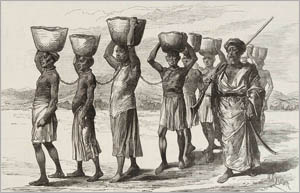
    Fun facts of slavery- Image of The Rise of Slavery

    Fun Facts

    • In the 1600s, Europeans brought slaves to the New World. Many of these slaves were kidnapped by African slave traders. The terrified men, women, and children walked hundreds of miles across Africa to the Gold Coast in north-western Africa.

    • They were then chained and loaded so tightly onto boats that they could barely move. As many as 25 percent – approximately 2 million Africans – died during the voyage. Many became sick and died from disease. Others jumped overboard.

    • The ships sailed from Africa’s coast to the West Indies in the Caribbean Sea. Here, the slaves were inspected to make sure they were healthy. They were trained and sold in auctions. They were then loaded on boats bound for America.

    • Europeans traded salted fish, guns, rum, and iron bars used as money for the slaves.

    • Most of the slaves brought to America lived in the South, many of them on plantations. Field hands worked long hours under grueling conditions on the plantations. Household slaves had it better. They cooked, cleaned, sewed, and kept the gardens. Some slaves learned trades, such as carpentry or tanning. Some slave owners were kind, but many were very cruel.

    • Slaves in New England were usually treated better, although they weren’t free.

    • As the numbers of slaves in America grew, slave owners worried about uprisings. They made laws stating that slaves were to be treated as property. Slaves weren’t allowed to marry, although many did. Their children and spouses could be ripped away from them. It was against the law for a large group of slaves to gather in one place.

    • Slaves tried to keep their own culture alive. They created gospel music by mixing traditional African rhythms with Christian themes. They told stories and made art.

    Vocabulary

    1. Prosper: to thrive, flourish, do well

    2. Benefit: an advantage or gain

    3. Grueling: exhausting

    Questions and Answers

    Question: Why didn’t the Founding Fathers and early colonists understand that slavery was wrong?

    Answer: That’s a good question with a complicated answer. First, some colonists did believe slavery was wrong but felt powerless to stop it. Unfortunately, slavery and other forms of oppression were common in many cultures. For hundreds of years in Great Britain, people lived under a feudal system, in which a few people owned most of the country’s land and wealth while the rest of the people lived in poverty. Children and women had few rights and were often poorly treated. Human life, in general, wasn’t highly valued. Slave traders and plantation owners were blinded by their own greed.

    Learn More

    Visit Scholastic to learn more about what it was like to be a slave.