• Tag Archives: Native Americans

    Britain’s Allies

    Not everyone was happy when America won its independence from Great Britain. Many people, particularly wealthy slave-owners in the southern states, remained sympathetic to Great Britain. These people were known as Loyalists or Tories. Many black slaves and Native Americans fought for the British, as well.
    Image for Britain’s Allies
    Fun Facts for Britain – Image for Britain’s Allies

    Fun Facts

    • About one-fifth of the colonists were Loyalists. These included government leaders, such as Governor Thomas Hutchinson and many pastors and priests of the Church of England.

    • Another one-third of the colonists remained neutral during the war, refusing to take sides.

    • The Loyalists were hated by the colonists and sometimes experienced mob violence. Over 80,000 Loyalists fled, mostly to Canada.

    • Benedict Arnold was a brilliant American war hero. Unfortunately, his pride got the better of him. He felt that Congress had failed to appreciate him and made a deal with General Burgoyne to sell the fort, West Point, to the British. The plot was discovered and Arnold was branded a traitor to America. He became a British general, but the British never really trusted him.

    • Native Americans believed that if the Americans won, they would lose more of their rights and their land, which was true. Many tribes, such as the Cherokee tribe, fought against the Patriots. After the war, all tribes – even those who had fought with the colonists – were displaced from their land and forced further west.

    • The Declaration of Independence made no mention of freedom for slaves. During the war, the governor of Virginia declared freedom for any slave who would fight for the British. More than 800 slaves took up arms against the colonists and more than 50,000 slaves fled from their owners.

    Vocabulary

    1. Neutral: to remain without a position or opinion

    2. Traitor: one who betrays his country or friends

    3. Displace: to uproot

    Questions and Answers

    Question: Were the Loyalists outspoken about their opinions?

    Answer: Some were, especially in the beginning, but many people on both sides quietly supported their causes. Some acted as spies. Those with money offered financial support.

    Learn More

    Visit PBS to play a game, “The Road to Revolution.”
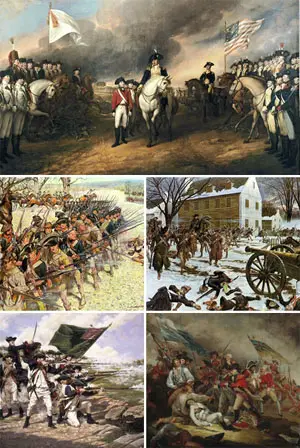
    The Revolutionary War

    The Revolutionary War began on April 19, 1775 at Lexington and Concord, Massachusetts. It would last six years, ending with General Cornwallis’s surrender in Yorktown, Virginia on October 19, 1781. More than 25,000 Americans died during this war. Considering that Great Britain was one of the most powerful countries in the world at the time, their victory was astounding.

    Fun facts of Revolutionary War- Image of Revolutionary War
    Fun facts of Revolutionary War- Image of Revolutionary War


    Fun Facts

    • George Washington was the leader of The Continental Army. He was a brilliant and inspiring general who eventually led relatively untrained soldiers to victory. Most of the soldiers were farmers or working men. They were promised $60 a year, food, and clothing for enlisting.

    • The British expected a quick victory. They defeated the rebels at Bunker Hill and captured New York, driving Washington and his men back to New Jersey. They captured Fort Ticonderoga and won battles at Brandywine and Germantown in Pennsylvania.

    • On December 25, 1776, Washington and his men crossed the icy Delaware River. At dawn, they captured Hessian (German) soldiers at Trenton, New Jersey. The following week, they won again at Princeton. The tide seemed to be turning.

    • During the summer of 1777, British General John Burgoyne hatched a plan to combine troops with two other forces in New York. If the plan had worked, the war probably would have been over. More than 10,000 American Patriots blocked their path. At the Battle of Saratoga in October of 1777, General Burgoyne surrendered 6,000 men. This was a tremendous victory of the Americans.

    • Realizing that the Americans had a chance of winning, France jumped in, sending money, supplies, and later troops and ships. France is often called America’s oldest ally. Without their help, the war might have had a very different ending.

    • The Continental Army spent the winter of 1777-1778 at Valley Forge. Cold, hungry, and sick, almost 25 percent of the army died. During this time, German volunteer, Baron Friedrich von Steuben, trained the soldiers. By spring, they were ready to fight.

    • In December 1778, General Henry Clinton attacked Charleston, South Carolina. The Americans were badly defeated here and the British controlled much of South Carolina and Georgia.

    • In the summer of 1781, British General Charles Cornwallis stationed his troops at Yorktown, Virginia where they were waiting for aid from British warships. Washington brought the Continental Army, as well as 5,000 French troops to Yorktown. At the same time, French naval fleets drove off the British ships. The British troops were trapped. Cornwallis surrendered on October 19, 1871. The Americans had won the war.

    Vocabulary

    1. Enlist: to sign up as a soldier

    2. Ally: a friend, partner

    3. Surrender: to admit defeat

    Questions and Answers

    Question: What qualities helped the Americans win?

    Answer: The British soldiers marched in straight lines as they charged into battle. The Americans made up their own rules. They hid behind rocks and trees, making it hard for the British to fight them. They knew the terrain well and could live off the land if necessary. Most important, though, was the Patriots’ belief in the ideals of freedom and democracy, which united them, even through hardship.

    For example, Nathan Hale, a 21-year-old school teacher, volunteered to be a spy for the Continental Army. The British caught him and hanged him. Before his death, he said, “I regret that I have but one life to give for my country.” Many people shared his deep sense of patriotism and love for America.

    Learn More

    VisitPBS Learning to watch a video about the Declaration of Independence and the 4th of July.

    The First European Explorers to America

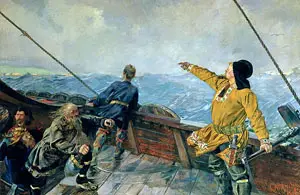
    Was Christopher Columbus the first European to reach the American continents? His expedition was certainly well-documented, but it wasn’t the first. Around 1000 A.D., almost five hundred years before Columbus landed in the West Indies, Leif Erikson, a Viking explorer, landed on Canada’s eastern shore.

    Image of First European Explorers
    Image of First European Explorers

    Fun Facts

    • Erikson was the son of the legendary Viking explorer, Erik the Red. Erik the Red left Norway and settled Greenland.
    • Erikson traveled back to Norway where he met King Olaf. He converted to Christianity. King Olaf asked him to take his new religion back to Greenland.
    • On the return voyage, Erikson sailed off course and landed in Newfoundland. He named the land, Vinland, because of its abundant wild grapes and fertile soil.
    • Erikson and his men stayed for a few years but left and never returned because of conflicts with the Native Americans who lived there.
    • Apparently, Erikson came upon several Indians sleeping under their overturned canoes shortly after he arrived in North America. He and his men killed all the Indians. You can imagine why the Indians weren’t friendly.

    Vocabulary

    1. Expedition: a planned journey or exploration
    2. Well-documented: thoroughly recorded
    3. Convert: to join a specific religion or way of life
    4. Fertile: rich; capable of giving life

    Questions and Answers

    Question: How do we know about Leif Erikson’s adventures?

    Answer: We know about his trip from two Viking sagas, or epic stories, which have been recorded and handed down over the centuries. These accounts differ somewhat so archeologists aren’t sure exactly what happened. Scientists have discovered a site in Newfoundland which they believe to be the Viking settlement.

    Learn More

    Visit UNESCO to see photos of the Viking settlement remains.

    Native Americans Today

    During the 1800s, thousands of Native Americans died from combat, disease, or starvation. Many tribes disappeared altogether. Native Americans living on reservations struggled to survive while teaching their children their traditions and culture.

    Fun facts of Native Americans- Image of Native Americans Today
    Fun facts of Native Americans- Image of Native Americans Map

    Fun Facts

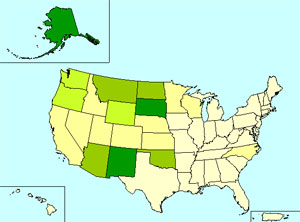
    • Today, Native American populations are growing. Over half of all Native Americans do not live on reservations. 300 federal reservations exist in the U.S., comprising over 52 million acres of land.
    • Native American children attend schools where they learn to read and write in English. Families often teach children their native language, culture, and traditions.
    • Native Americans participate in powwows, where they perform competitive dances to beating drums.
    • Native Americans are still known for their handicrafts – beautiful jewelry, rugs, and baskets.
    • Native Americans living on reservations face many struggles, including poor health and healthcare, crowded, substandard housing, poverty, and lack of employment opportunities.

    Vocabulary

    1. Population: group of people
    2. Native: first or original
    3. Substandard: below an acceptable level of quality

    Questions and Answers

    Question: Why do Native Americans still struggle so much?

    Answer: There is no single answer to this question. Unfair government policies are one reason, along with a lack of education and employment opportunities. Rates of depression, violence, and alcoholism are high on reservations.

    Learn More

    Visit PBS to learn more about Native Americans today.

    Head over to PBS Learning to go on a virtual field trip to a Native American village.

    Native Americans and Europeans

    When Christopher Columbus landed in the Caribbean in 1492, native tribes there believed the visitors were powerful spirits who came from the sky. If only they had known the devastation that would follow for their people. Columbus’s discovery brought new opportunity for Europeans. Some settlers came looking for gold and wealth; others came hoping for religious freedom. Some came as prisoners or slaves, while others came merely looking for a better way of life. Few European colonists considered the impact their conquests had on the native people. Many colonists saw Native Americans as savages who had little in common with them and did not need or deserve the same rights or treatment. Those who spoke out in favor of Native American rights were rarely heeded.

    Image of Native Americans and Europeans
    Image of Native Americans and Europeans

    Fun Facts

    • In 1492, there were between 5 and 15 million Native Americans in Canada and the United States. Over the next 300 years, those numbers dropped by 90 percent.
    • European settlers didn’t understand Native American culture. They viewed Native Americans as a wild, godless people. Europeans wanted to teach them European ways of dressing, eating, living, and learning. Missionaries tried to convert Native Americans to their religions.
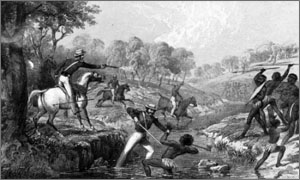
    • European settlers often had disputes with Native Americans over land. The Native Americans, with their swords, knives, and bows and arrows, were no match for European guns.
    • Many Native Americans died in combat. Thousands more died from diseases, such as smallpox, measles, mumps, influenza, chickenpox, and tuberculosis, brought by the Europeans. The Indians had never been exposed to these diseases and had no resistance.
    • In 1830, President Andrew Jackson signed a bill requiring Native Americans to move from their tribal homelands to reservations – or land set apart for them. Native Americans weren’t allowed to argue their cases in court. If they resisted moving, they could be killed.
    • Soon after, soldiers forced Native American tribes in the Southeast to move west to what is now Oklahoma. Many of these Indians had adopted European ways. These Indians had built homes, churches, and schools, and taught their children to read and write. Over 16,000 Cherokees were forced to march to their new home. Two thousand died during the journey; another 2,000 died shortly after they arrived in Oklahoma. The Cherokees named this journey, “The Trail of Tears.”
    • Unfortunately, most of the reservations were placed on poor soil and in harsh climates – places the Europeans didn’t want. The Native Americans struggled to survive here. In 1850, the land set aside for reservations included almost all the land from the Missouri River to the West Coast. Today, reservations make up a tiny portion of land in states like Arizona, New Mexico, Nevada, North and South Dakota, Wyoming, and Idaho.

    Vocabulary

    1. Devastation: total loss or ruin
    2. Savage: wild, lawless
    3. Dispute: conflict, disagreement

    Learn More

    Visit the History Channel to watch a video about the last battle of the Sioux Indians.