
• Tag Archives: President Nixon Facts

    Foreign Affairs in the 1980s

    Internationally, the early 1980s were a tough time for the U.S. Arab nations became increasingly opposed to Western interference and terrorists hijacked planes and bombed buildings to make their point. The late 1980s ushered in the end of Communism in several countries and the collapse of the Soviet Union, an event that seemed impossible just a few short years earlier.
    Fun Facts

    • Nixon and Carter had both attempted to improve relationships with the Soviet Union, but relationships soured when the Soviets invaded Afghanistan in 1979. Reagan called the Soviet Union the “evil empire.” He urged Congress to develop a defense system capable of destroying incoming missiles and build up the country’s arsenal of nuclear missiles.
    • Arab terrorists, angered at America’s support of Israel in Arab-Israeli conflicts, launched terrorist attacks that continue to be a problem today. For example, 40 people were killed in 1983 when the U.S. Embassy in Beirut was bombed. That same year, terrorists drove a truck loaded with bombs into U.S. Marine headquarters in Beirut, killing 241 Americans.
    • President Reagan wanted to help anti-communist guerillas (Contras) fighting in Nicaragua. Congress ordered a halt to all aid to the Contras. Some of Reagan’s top advisors, known as The Enterprise, hatched a secret scheme to get money for the Contras by selling arms to Iran. Although Reagan’s involvement in this scheme was never fully unraveled, when this plot became known, six members of the secret group were charged with minor crimes. This was known as the Iran-Contra Scandal and it made only a small dent in Reagan’s popularity.
    • Relations with the Soviet Union had been tense since after World War II, but the Cold War came to an end in the late 1980s. A new Russian leader, Mikhail Gorbachev, came to power and appeared willing to work with the U.S. Reagan and Gorbachev agreed to reduce their weapons.

    Vocabulary

    1. Hijack: to take control of a plane by force
    2. Scheme: a plan

    Questions and Answers

    Question: Was the wall in Berlin a real wall?

    Answer: Soviet leaders built the wall in 1961 to separate and contain Communist East Germany from West Germany, which was a democracy controlled by France, England, and the U.S. The wall was built over night and prevented anyone on the east side from escaping to the west. People were trapped. Some lost their jobs or couldn’t see their families who were on the west side of the wall. This wall was a literal symbol of the division between freedom and oppression.

     Mikhail Gorbachev increased liberties and freedom in the Soviet Union. His ideas spread to other Eastern European countries. These countries, including Poland, Czechoslovakia, East Germany, and Romania, overthrew their Communist governments and demanded democratic governments. In November, 1989, Germans tore down the Berlin Wall. Throughout Germany – and the Western world – people celebrated their freedom.

    Learn More

    Visit the BBC to learn more about the Berlin Wall.

    Nixon and the Watergate Scandal

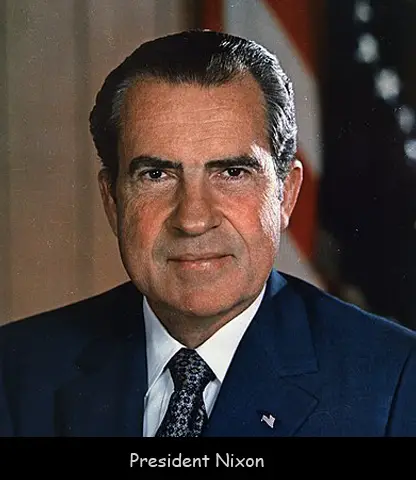
    President Nixon had high hopes when he took office. He hoped to win the Vietnam War and be remembered as a peacemaker. He succeeded at some of his goals, but he’s most remembered for the presidential scandal Watergate.


    Fun Facts

    • President Nixon removed 25,000 troops from Vietnam in June, 1969 and continued the Paris peace talks Johnson had begun during his presidency.
    • At the same time, Nixon ordered a secret bombing mission in Cambodia to stop Viet Cong leaders from sneaking weapons and troops into South Vietnam. After pulling troops out of Vietnam, Nixon promised South Vietnamese leaders that America would still help them if necessary. This was a promise he couldn’t keep.
    • In 1971, Nixon visited China. Since Communists took over China after World War II in 1948, U.S. leaders had refused to deal with the country. Although strongly against Communism, Nixon wanted to improve relationships through understanding. His visit was a success.
    • Nixon also visited Moscow in the Soviet Union in 1972. The two countries agreed to work together on space exploration.
    • Nixon easily won the election in 1972, but his political career began to unravel after that. During the election, five men broke into the Democratic Party headquarters. This was not an ordinary burglary. The men had wiretapping equipment and were there to gather information against the Democratic Party that could be used by Nixon’s campaign.
    • The incident was brushed under the carpet until one of the burglars wrote a letter to the trial judge, John J. Sirica. The letter said that administration officials had planned the break-in.
    • The Senate formed a special committee to investigate the allegations. Nixon tried to cover up the Watergate burglary, refusing to hand over recorded conversations to authorities. The Supreme Court ruled that he must hand over the tapes.
    • In 1974, Nixon released the tapes which showed that he had lied about his involvement in the break-in. The House of Representatives found reason to impeach him and it seemed clear that the Senate would convict him. Nixon resigned on August 8, 1974, rather than face impeachment. He is the only U.S. president ever to resign.

    Vocabulary

    1. Watergate: Watergate was the name of the hotel complex in Washington D.C. where the break-in occurred.
    2. Impeach: to charge a public official with misconduct
    3. Convict: to find guilty

    Questions and Answers:

    Question: What happened after President Nixon resigned?

    Answer: In 1973, Vice President Spiro Agnew was charged with accepting bribes while governor of Maryland. He was also charged with tax evasion. President Nixon chose Gerald R. Ford to replace Agnew. When Nixon resigned, Ford became president.

    Learn More

    Visit Scholastic to read more about the Watergate scandal.