
• Tag Archives: Watergate Scandal Facts

    America the Great? The New Reality of the 1970s

    The Vietnam War and the Watergate scandal left Americans feeling discouraged and battered. No longer was America the country with all the answers. Some problems couldn’t be solved, and the challenges weren’t over. Through the 1970s, the country encountered one struggle after another.
    Fun Facts:

    • In the 1960s, America started importing oil from other countries to fuel its growing energy needs.
    • By the 1970s, most of America’s oil came from countries in the Middle East – members of OPEC, the Organization of Petroleum Exporting Countries. In 1973, OPEC countries stopped shipping oil to America. OPEC leaders were angry that America was supporting Israel in a war against Egypt and Syria.
    • In 1979, OPEC raised oil prices by 60 percent in response to a global oil shortage. In America, gas prices; gas stations often ran out of gas. Cars waited in long lines outside of gas stations to get gas. People had to pay more to heat their homes. Americans responded by buying smaller, more fuel-efficient cars, carpooling, and turning down their heaters.
    • Jimmy Carter took office in 1976. He hoped to promote peace and improve human rights conditions around the world.
    • The economy grew slowly. People lost their jobs while at the same time, their expenses grew. The prosperity of the 1950s and 1960s was over.
    • The Soviet Union invaded Afghanistan to prop up a pro-Soviet government. In response, President Carter placed an embargo on shipments of grain to the Soviet Union. The U.S. also boycotted the 1980 Summer Olympics, which were held in Moscow.
    • In 1979, the Shah of Iran was overthrown in a revolution. The Shah, who was dying, came to the U.S. for medical treatment. In retaliation, Iranian revolutionaries took 52 Americans hostage at the U.S. embassy in Iran. They wanted the Shah returned to Iran for trial. The Shah died in America but the revolutionaries continued to hold the hostages. They were finally released on January 31, 1981, the day Ronald Reagan took office as president. They had been held hostage for 444 days.

    Vocabulary

    1. Import: to buy from another country
    2. Embargo: an official ban on trade
    3. Boycott: to limit or sever a political or social relationship as a form of protest

    Questions and Answers:

    Question: Could an energy crisis happen again?

    Answer: The energy crisis of the 1970s made Americans more aware of the danger of relying too much on other countries for oil. Since then, scientists have been working hard to develop new technologies and find energy resources, such as wind and solar energy, here in the U.S. These technologies are expensive and take time to develop. We are still a long way off from being energy efficient. At the same time, we have to balance our need for more energy with maintaining a healthy environment.

    Learn More

    Visit Energy Star Kids to play some conservation games and learn more about energy.
    Nixon and the Watergate Scandal

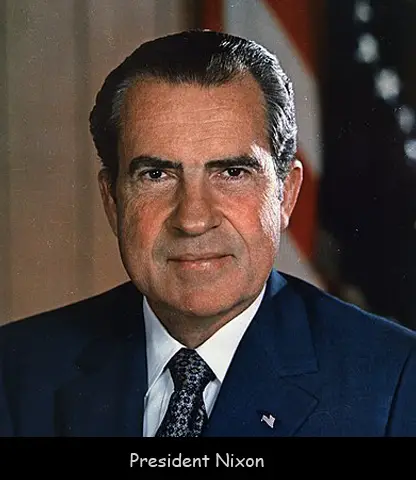
    President Nixon had high hopes when he took office. He hoped to win the Vietnam War and be remembered as a peacemaker. He succeeded at some of his goals, but he’s most remembered for the presidential scandal Watergate.


    Fun Facts

    • President Nixon removed 25,000 troops from Vietnam in June, 1969 and continued the Paris peace talks Johnson had begun during his presidency.
    • At the same time, Nixon ordered a secret bombing mission in Cambodia to stop Viet Cong leaders from sneaking weapons and troops into South Vietnam. After pulling troops out of Vietnam, Nixon promised South Vietnamese leaders that America would still help them if necessary. This was a promise he couldn’t keep.
    • In 1971, Nixon visited China. Since Communists took over China after World War II in 1948, U.S. leaders had refused to deal with the country. Although strongly against Communism, Nixon wanted to improve relationships through understanding. His visit was a success.
    • Nixon also visited Moscow in the Soviet Union in 1972. The two countries agreed to work together on space exploration.
    • Nixon easily won the election in 1972, but his political career began to unravel after that. During the election, five men broke into the Democratic Party headquarters. This was not an ordinary burglary. The men had wiretapping equipment and were there to gather information against the Democratic Party that could be used by Nixon’s campaign.
    • The incident was brushed under the carpet until one of the burglars wrote a letter to the trial judge, John J. Sirica. The letter said that administration officials had planned the break-in.
    • The Senate formed a special committee to investigate the allegations. Nixon tried to cover up the Watergate burglary, refusing to hand over recorded conversations to authorities. The Supreme Court ruled that he must hand over the tapes.
    • In 1974, Nixon released the tapes which showed that he had lied about his involvement in the break-in. The House of Representatives found reason to impeach him and it seemed clear that the Senate would convict him. Nixon resigned on August 8, 1974, rather than face impeachment. He is the only U.S. president ever to resign.

    Vocabulary

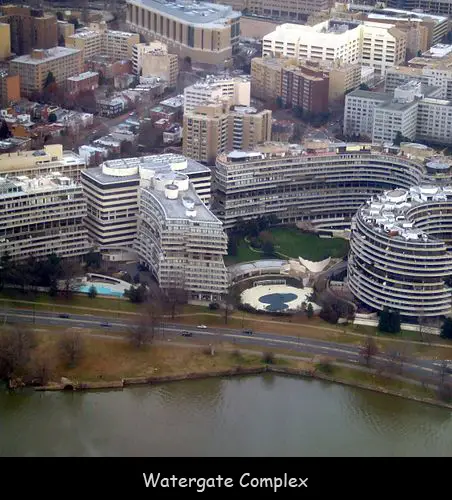
    1. Watergate: Watergate was the name of the hotel complex in Washington D.C. where the break-in occurred.
    2. Impeach: to charge a public official with misconduct
    3. Convict: to find guilty

    Questions and Answers:

    Question: What happened after President Nixon resigned?

    Answer: In 1973, Vice President Spiro Agnew was charged with accepting bribes while governor of Maryland. He was also charged with tax evasion. President Nixon chose Gerald R. Ford to replace Agnew. When Nixon resigned, Ford became president.

    Learn More

    Visit Scholastic to read more about the Watergate scandal.
