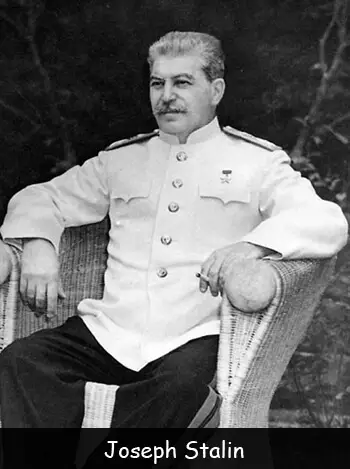
During World War II, the Soviet Union allied with Britain, France, and the U.S. After the war, though, that relationship soured. Communist leader, Joseph Stalin refused to remove troops from European countries previously occupied by the Germans. Instead, he took over those countries, establishing Communist governments in Bulgaria, Czechoslovakia, Hungary, Poland, and Romania. Winston Churchill warned that Stalin was placing an “Iron Curtain” over Europe. Elsewhere in Asia, Communism was spreading as well.
Fun Facts
- Joseph Stalin ruled the Eastern Block, as these countries were known, as a dictator. He allowed no free elections and political rivals were often intimidated or even murdered.
- The invention of the atomic bomb and nuclear weapons made war a much more dangerous prospect. Whole cities could be destroyed within minutes. The Cold War was not a military war, but a war of ideas. Communist and Allied leaders distrusted each other and citizens lived with the constant fear that the other side would use nuclear weapons.
- Americans were prepared for the possibility of a nuclear attack. Public buildings and even private homes included fallout shelters – steel or concrete structures that contained food, water, and medical supplies. Children were trained at school about what to do if a nuclear attack happened.
- As the Soviet Union began seeking power over Turkey and Greece, President Truman created a policy called “The Truman Doctrine,” which said that America had an obligation to “support free people who are resisting attempted subjugation by armed minorities or by outside pressures.”
- Americans feared that Communist leaders and spies were infiltrating their country. In 1947, President Truman created the Loyalty Review Board. This board investigated 3 million government employees and fired 212 people who were considered potential security risks.
- Julius and Ethel Rosenberg were charged of espionage – of giving atomic bomb secrets to the Russians. They were convicted and executed in 1953. Historians still wonder whether they were really guilty.
- Wisconsin senator, Joseph McCarthy claimed he had the names of 205 communists working for the U.S. government, sparking a period of fear and hysteria known as the McCarthy Era. He accused many people, including writers, actors, movie producers, military leaders, and even President Truman, of being Communists. He used verbal attacks and bullying to intimidate people. Anyone who spoke out against him faced being named as a communist.
- Finally, in 1953, during a public hearing of high-ranking army leaders, quiet, mild-mannered attorney, Joseph Welch had had enough of McCarthy’s rude behavior. He said, “Have you no sense of decency, sir? At long last, have you left no sense of decency?”
- Welch’s simple question seemed to break the spell. Everyone in the courtroom began clapping. After that, McCarthy’s reputation declined and in 1954, the Senate condemned his behavior as dishonorable.
Vocabulary
- Subjugation: to overpower or oppress
- Infiltrate: to gradually gain access or permeate
Questions and Answers
Question: Why did Communism scare American leaders so much?
Answer: In Communist countries, the government controls all property. People are assigned work, based on their skills; they are given food, clothing, shelter, and other items based on their need. Religion of any kind is not allowed, nor is the media allowed to speak freely. These practices go against the ideals of democracy and freedom – that men can think for themselves, elect leaders to govern them, and choose where and how to work and live.
Learn More
Visit the Library of Congress to learn more about the Cold War.