• Tag Archives: World War I

    Social Unrest after World War I

    After World War I, America went through a great shift in moral and social values. Before the war, most people believed in traditional values of hard work, family, and religion. After the war, many people felt suspicious and afraid. They disagreed on what should happen in America.


    • Schools adopted new progressive educational practices. Teachers were instructed to let children learn through hands-on methods. Children were taught by looking at and memorizing words, rather than through phonics instruction. Tests were used to measure performance. Most schools still use these techniques.
    • People distrusted others who were different than them. The Klu Klux Klan dressed in white robes and hoods, holding parades and demonstrating against Catholics, Jews, foreigners, African-Americans, and radicals. They controlled the politics of many small towns and sometimes terrorized others.
    • New political ideas emerged, such as Communism. People worried that a Communist revolution might happen in the U.S. Radicals sent bombs in the mail to prominent U.S. citizens and politicians. No one was killed and the post office found most of the bombs, but Americans were frightened.
    • Women began wearing short skirts, cutting their hair, and wearing makeup. These women, known as flappers, were part of a young crowd that wanted to have fun. They enjoyed going to dances, drinking, and living a life with few rules. Moving pictures and radio offered entertainment. Crossword puzzles, beauty pageants, and dance marathons became fads.
    • Others longed for a return to traditional values. Prohibition was a law that made it illegal to make, sell, or buy alcohol. It didn’t work very well. People went to hidden bars and clubs (speakeasies) to get alcohol.

    Vocabulary

    1. Phonics: the system of learning to read based on the sounds of the alphabet
    2. Radical: someone with extreme political views
    3. Communism: a form of government found at the time in Russia and China. In Communism, all forms of religion are generally prohibited. The government owns all property and citizens are given work assignments.


    Questions and Answers

    Question: How did this time change America?

    Answer: For the first time, American culture was driven by media. Radio, moving pictures, and easy access to magazines and newspapers influenced people’s ideas. Many people felt rebellious and cynical. Family life seemed less important. This shift in values had a profound effect on America. Do you think it was positive?

    Learn More

    Visit Scholastic to learn more about Communism.
    The American Economy after World War I

    Immediately after World War I, America went through an economic downturn but quickly recovered. In fact, Americans had never had so much money or so much free time. New advances in technology meant that products could be made more quickly and cheaply than ever before. In 1927, the U.S. dollar was worth one-third more than it had been worth in 1914.

    The American Economy after World War I

    Fun Facts

    • Working class families could now afford to buy vacuums, furniture, and other household goods.
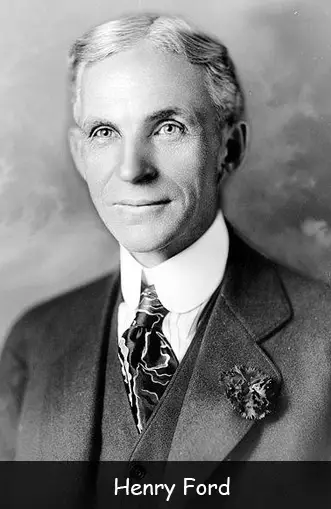
    • People began wanting and expecting more. Henry Ford introduced the idea of credit – a person could make a small down payment for a car and make payments each month until the car was paid for. Soon, people were using credit to buy furniture, appliances, and houses. This system allowed people to buy more things that they could if they paid in cash.
    • Women had gone to work during the war. Many of them went back to being homemakers, but about 25 percent remained in the workforce.
    • People felt optimistic that the good times would last forever, but by the late 1920s, problems in the economy began to appear. Few people paid attention to the warning signs.
    • Not everyone enjoyed the new prosperity. As land prices increased and food prices decreased, farmers struggled. Many of them had purchased farm machinery on credit, but couldn’t pay off their debts. Over 13 million acres of farmland were left vacant as farmers moved to cities to find work.
    • Advertisers began aggressively selling products and people kept spending money. More and more Americans carried debt. This debt made it difficult for them to save money. If something happened, such as a health problem or a job loss, they would be in serious trouble.
    • People began investing in the stock market, sometimes buying “on margin,” which was like taking a loan from a stockbroker to buy a stock.

    Vocabulary

    1. Vacant: empty
    2. Stockbroker: someone who buys and sells stocks on behalf of a client
    3. Debt: money that is owed to someone else

    Questions and Answers

    Question: What would happen if people had bought everything they needed?

    Answer: That’s exactly what did happen. Americans had purchased all the furniture, appliances, and home goods they needed, but factories kept on making more items. Soon these items began piling up. Factories weren’t selling goods so they weren’t making money. When they didn’t make money, they couldn’t pay their employees. When the employees were laid off, they couldn’t pay back their debts.

    Learn More

    Visit Dave Ramsey to learn more about managing money wisely.

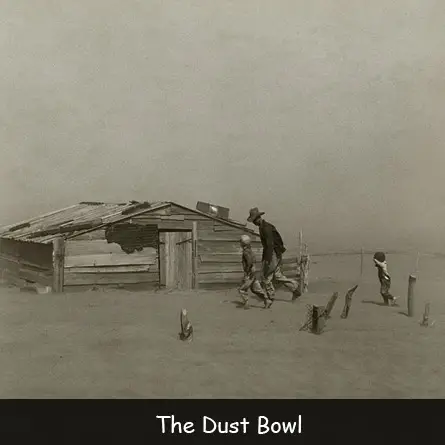
    The Dust Bowl

    From the mid-1800s, homesteaders and farmers in the Mid-West had plowed and worked the flat, treeless prairie land. Most of them had no understanding of the need to rest or restore the soil by adding compost, planting trees, or rotating crops. Slowly the soil lost the organic material that made it rich and fertile. Then, from 1933 to 1936, a huge drought came, turning the lifeless soil to dust.

    The Dust Bowl

    Fun Facts

    • After World War I, wheat prices rose and people flooded to the plains area to begin farming. Native grasses were stripped as the fields were plowed for crops. Investors urged farmers to plant more and more crops, with no regard to good farming practices designed to protect the soil.
    • When the Great Depression hit, wheat prices fell, yet farmers kept planting crops as they tried to make a living.
    • In 1934, almost no rainfall fell in the region and temperatures regularly rose above 100 degrees. The dusty soil baked in the heat. Dust storms became a common occurrence. These “black blizzards” lifted the topsoil into the air, turning the day to night. Animals and even people were smothered in the storms. Homes were filled with a constant layer of dust.
    • On April 14, 1935, people woke to blue skies. After several weeks of dust storms, they hoped that the weather would finally improve. But late in the afternoon, a cold front blew winds from Canada, raising dust from North Dakota all the way to Texas in the worst dust storm yet. On this day, known as “Black Sunday,” over 300 million tons of top soil blew all the way to the Atlantic Ocean and the Gulf of Mexico.
    • For many, Black Sunday was the final straw. People from North Dakota to New Mexico were affected, although Oklahoma, Kansas, New Mexico, Texas, and Colorado were the hardest hit.
    • Over one million people left their homes. Many of them headed west to work on farms in California. These migrant workers lived in tents or shacks, moving from place to place as farmers needed labor.
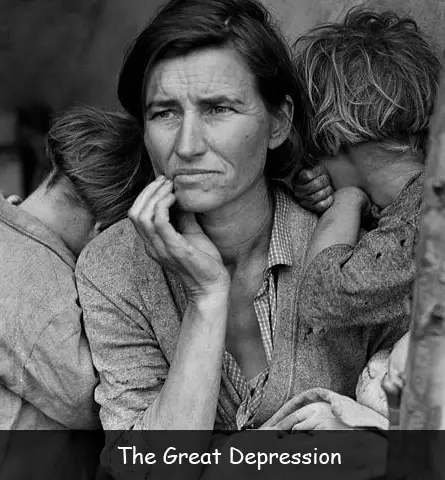
    • Dorothea Lange was a photographer living in San Francisco. After watching hungry people stand in breadlines waiting for food, she began photographing those who had come from the Dust Bowl, as the area was called. Her photos were published in newspapers around the country and created an awareness of the suffering these people endured.
    • Writer, John Steinbeck’s book, The Grapes of Wrath, also helped Americans understand the tragedy of the Dust Bowl. Folk singer, Woodie Guthrie, who lived through Black Sunday, wrote songs about the ordeal.

    Vocabulary

    1. Compost: a rich soil builder made from decomposed plant material and animal waste
    2. Migrant worker: one who moves from place to place for work, typically farm work
    3. Drought: a period with no rain

    Questions and Answers

    Question: Could a dust bowl happen again?

    Answer: Most of the country’s farms are now owned by large corporations, rather than small farmers. These corporations should use good farming practices, but if they overuse the soil, a dust bowl could occur again.

    Learn More

    Visit Scholastic to watch a video about the Dust Bowl.

    The Great Depression Begins

    The fast lifestyles and excessive spending of the 1920s couldn’t last forever. Too many people had bought stocks on margin (taken loans to buy stocks). Most Americans already owned cars and household goods, yet factories kept pumping out more products that no one was buying. Prices for food dropped and farmers weren’t getting paid. Already in debt, many farmers couldn’t pay their bills and lost their farms. Then on October 29, 1929, the stock market crashed. Investors lost nearly $8 billion in one day. The country was already in economic trouble. The stock market crash pushed America over the edge.

    The Great Depression Begins

    Fun Facts

    • People had made huge fortunes in the stock market, but after the crash, they lost faith in it. Stock brokers demanded that people pay their margin loans; banks demanded that stock brokers pay back their loans. But because the stocks had no value, people couldn’t pay back their loans.
    • People took their money out of banks too, causing banks to fail.
    • Factories started closing and laying people off. Without jobs, these people had no way to support their families.
    • Through most of the 1920s, the unemployment rate was around 5 percent, but it jumped to almost 25 percent in 1932. People lost their homes and men traveled on foot or by train to other towns in search of work.
    • Charities and local governments tried to help, but they quickly ran out of money too.
    • President Hoover worried about creating government programs to solve the economic problems. He believed in a small federal government that supports strong state and local governments. He was afraid that people would become permanently dependent on government programs to take care of them.
    • Hoover asked state governments to create projects that would provide jobs, such as building the Hoover Dam. These programs weren’t enough to pull the country out of the Great Depression.
    • People were angry at President Hoover. They wanted him to do more. Veterans of World War I set up cardboard and tin shacks at the capitol in Washington D.C. They wanted Congress to pay bonuses, which weren’t scheduled to be paid until 1945. Congress refused to release the payments and sent troops to dismantle the shacks. Americans were furious.
    • Homeless people lived together in city parks. They named their communities, “Hoovervilles” and slept under newspapers they called, “Hoover blankets.”

    Vocabulary

    1. Margin: to buy stock with borrowed money
    2. Veteran: someone who has served in the military
    3. Shack: small, primitive building or home

    Questions and Answers

    Question: Should President Hoover have done more to help the country?

    Answer: People still disagree about that. President Franklin D. Roosevelt started many social programs when he took office after Hoover. These programs did relieve suffering and did help pull the country out of the Depression. These social programs were meant to be short-term, but continue today. They probably have made people more dependent on the government, in some cases, just as Hoover feared. They’ve also created national debt.

    Question: Could a depression happen again?

    Answer:It’s possible. The Great Recession of 2008-2010 was a time of serious economic stress for America. There have been other periods of financial struggle and it’s likely that there will be again. But, people can be prepared for these times by avoiding debt, living simply, and setting aside emergency savings.

    Learn More

    Visit Scholastic to read firsthand accounts of what life was like during the Great Depression.

    Learn more about managing money well.