All posts by americanadmin

Paul Revere’s Ride by Henry Wadsworth Longfellow

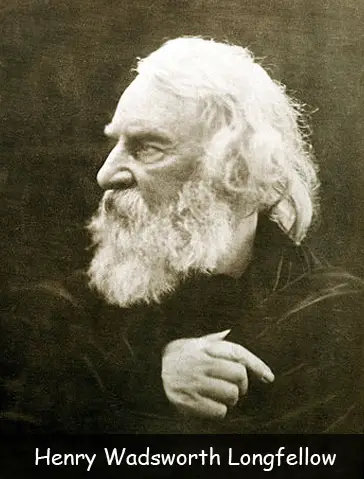
Henry Wadsworth Longfellow was a beloved 18th century poet, known for his patriotic and philosophical themes. He wrote poems about Native Americans, the Civil War, and of course, the Revolutionary War.

Longfellow’s family had deep colonial roots. His grandfather’s home had been burned to the ground by British soldiers, and several family members were involved in politics.

Longfellow wrote the following poem to honor Revolutionary War hero, Paul Revere. If you like the poem, you might like the beautiful book illustrated by Ted Rand. Or listen to a rap version here.

  Listen, my children, and you shall hear
Of the midnight ride of Paul Revere,
On the eighteenth of April, in Seventy-five;
Hardly a man is now alive
Who remembers that famous day and year.

    He said to his friend, “If the British march
By land or sea from the town to-night,
Hang a lantern aloft in the belfry arch
Of the North Church tower as a signal light,–
One, if by land, and two, if by sea;
And I on the opposite shore will be,
Ready to ride and spread the alarm
Through every Middlesex village and farm
For the country folk to be up and to arm,”

    Then he said, “Good night!” and with muffled oar
Silently rowed to the Charlestown shore,
Just as the moon rose over the bay,
Where swinging wide at her moorings lay
The Somerset, British man-of-war;
A phantom ship, with each mast and spar
Across the moon like a prison bar,
And a huge black hulk, that was magnified
By its own reflection in the tide.

    Meanwhile, his friend, through alley and street,
Wanders and watches with eager ears,
Till in the silence around him he hears
The muster of men at the barrack door,
The sound of arms, and the tramp of feet,
And the measured tread of the grenadiers,
Marching down to their boats on the shore.

    Then he climbed the tower of the Old North Church,
By the wooden stairs, with stealthy tread,
To the belfry-chamber overhead,
And startled the pigeons from their perch
On the sombre rafters, that round him made
Masses and moving shapes of shade,–
By the trembling ladder, steep and tall
To the highest window in the wall,
Where he paused to listen and look down
A moment on the roofs of the town,
And the moonlight flowing over all.

    Beneath, in the churchyard, lay the dead,
In their night-encampment on the hill,
Wrapped in silence so deep and still
That he could hear, like a sentinel’s tread,
The watchful night-wind, as it went
Creeping along from tent to tent
And seeming to whisper, “All is well!”
A moment only he feels the spell
Of the place and the hour, and the secret dread
Of the lonely belfry and the dead;
For suddenly all his thoughts are bent
On a shadowy something far away,
Where the river widens to meet the bay,–
A line of black that bends and floats
On the rising tide, like a bridge of boats.

    Meanwhile, impatient to mount and ride,
Booted and spurred, with a heavy stride
On the opposite shore walked Paul Revere.
Now he patted his horse’s side,
Now gazed at the landscape far and near,
Then, impetuous, stamped the earth,
And turned and tightened his saddle-girth;
But mostly he watched with eager search
The belfry-tower of the Old North Church,
As it rose above the graves on the hill,
Lonely and spectral and sombre and still.
And lo! as he looks, on the belfry’s height
A glimmer, and then a gleam of light!
He springs to the saddle, the bridle he turns,
But lingers and gazes, till full on his sight
A second lamp in the belfry burns!

    A hurry of hoofs in a village street,
A shape in the moonlight, a bulk in the dark,
And beneath, from the pebbles, in passing, a spark
Struck out by a steed flying fearless and fleet:
That was all!    And yet, through the gloom and the light,
The fate of a nation was riding that night;
And the spark struck out by that steed, in his flight,
Kindled the land into flame with its heat.
He has left the village and mounted the steep,
And beneath him, tranquil and broad and deep,
Is the Mystic, meeting the ocean tides;
And under the alders, that skirt its edge,
Now soft on the sand, now loud on the ledge,
Is heard the tramp of his steed as he rides.

    It was twelve by the village clock
When he crossed the bridge into Medford town.
He heard the crowing of the co-ck,
And the barking of the farmer’s dog,
And felt the damp of the river fog,
That rises after the sun goes down.

    It was one by the village clock,
When he galloped into Lexington.
He saw the gilded weatherco-ck
Swim in the moonlight as he passed,
And the meeting-house windows, blank and bare,
Gaze at him with a spectral glare,
As if they already stood aghast
At the bloody work they would look upon.

    It was two by the village clock,
When he came to the bridge in Concord town.
He heard the bleating of the flock,
And the twitter of birds among the trees,
And felt the breath of the morning breeze
Blowing over the meadows brown.
And one was safe and asleep in his bed
Who at the bridge would be first to fall,
Who that day would be lying dead,
Pierced by a British musket-ball.

    You know the rest.    In the books you have read,
How the British Regulars fired and fled,–
How the farmers gave them ball for ball,
From behind each fence and farm-yard wall,
Chasing the red-coats down the lane,
Then crossing the fields to emerge again
Under the trees at the turn of the road,
And only pausing to fire and load.

    So through the night rode Paul Revere;
And so through the night went his cry of alarm
To every Middlesex village and farm,–
A cry of defiance and not of fear,
A voice in the darkness, a knock at the door,
And a word that shall echo forevermore!
For, borne on the night-wind of the Past,
Through all our history, to the last,
In the hour of darkness and peril and need,
The people will waken and listen to hear
The hurrying hoof-beats of that steed,
And the midnight message of Paul Revere.
Valley Forge

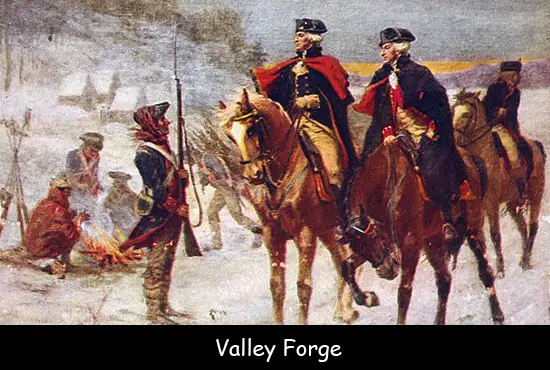
After Washington crossed the Delaware and won the battle at Trenton, more soldiers enlisted. They saw that Washington might have a chance of winning and they wanted to be part of that victory. But Washington’s challenges weren’t over. Valley Forge was a testing time.

Fun Facts

  • After the Battle of Trenton, Washington fought and lost two more battles against General Howe.
  • As winter approached, the British troops went to Philadelphia. Washington needed a winter camp for his troops too.
  • Washington’s men went to Valley Forge, which had once been an iron forge where men made horseshoes. Now it was just a hill by a river with a few farmhouses and trees nearby.
  • His army marched to Valley Forge in the rain. They were cold, wet, and tired. Their clothing and shoes were worn out. They needed shelter. The men cut down trees and built some simple houses.
  • It was a cold winter. The men had little to eat and they were cold. Their shoeless feet left blood in the snow.
  • That winter, Washington repeatedly wrote to Congress in Philadelphia asking for food, clothing, and shoes. Congress sent some food, but not enough, and no clothing. Washington wondered if the men would survive until spring.
  • Finally spring came. Washington had managed to keep his men together. They had become tougher and had spent time training. Their sacrifices had united them. During that winter, Washington stayed with the soldiers, even when other officers and generals returned to their homes. He suffered along with them. In return, they became very loyal to him.

Vocabulary

  1. Enlist: join
  2. Iron forge: similar to a blacksmith’s shop, a place where iron tools and materials are made

Questions and Answers

Question: Why didn’t Congress send supplies more quickly?

Answer: Partly because they were lacking in money, but also because they weren’t on the front line. It was hard for them to imagine, sitting in their comfortable homes, the reality of the soldiers’ lives.

Learn More

Watch a video about Valley Forge.

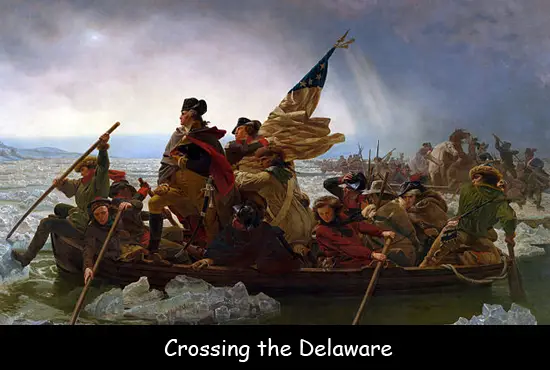
Crossing the Delaware

The Founding Fathers signed the Declaration of Independence. There was no going back. The country was at war. George Washington and his troops were ill-prepared and lacked weapons and supplies. They endured many discouraging moments, but Washington kept trying.

Fun Facts

  • English warships came to Long Island in the summer of 1776. The ships carried 20,000 soldiers. Some were English, some were paid German soldiers.
  • The English general, General Howe, had a strong army. He was ready to fight.
  • The English ships fired their guns and the soldiers came onto Long Island.
  • George Washington and his men fought hard, but by week’s end, 1,000 men had died. He knew he had to get off Long Island or lose all his men.
  • He sent his men for boats and when night came, they were ready to cross the river. A heavy fog hid the men from the English.
  • A woman who was loyal to the King saw the men. She sent her slave to alert General Howe. But the slave only found German soldiers who spoke no English. They couldn’t understand her.
  • In the morning, the English discovered that the colonial soldiers were gone.
  • After another battle in New York, George Washington needed to retreat again. He would have preferred to fight, but he needed more soldiers. He was waiting for the colonies to send more.
  • All that fall, the English soldiers chased after Washington’s troops. In December, Washington came to the Delaware River and Trenton, New Jersey. The men had marched for miles and were tired and cold, but Washington could not let them rest. German soldiers were close behind.
  • The men went across the Delaware River in boats. When the Germans arrived, they could not chase Washington’s men because there were no boats left.
  • The German soldiers celebrated Christmas night in Trenton. They sat by their fires and sang and drank wine.
  • Across the river, Washington’s soldiers were tired and discouraged. They had no fire or wine. They wondered if the war would ever end. But Washington had a plan. He knew the Germans were celebrating across the river and would not be up to fighting. This was his big chance.
  • 2,500 soldiers with their horses and guns loaded onto boats and crossed the Delaware River by night. Up the river, the ice was breaking up. The soldiers feared the ice would come down the river and hit their boats. Some turned back.
  • Those that pressed on landed at Trenton at 3 a.m. They marched on the German soldiers and took them by surprise. The German soldiers tried to rouse themselves, but it was too late. They were surrounded. Washington captured 1,000 men that day—his first victory.

Learn More

Watch a video about the crossing of the Delaware.

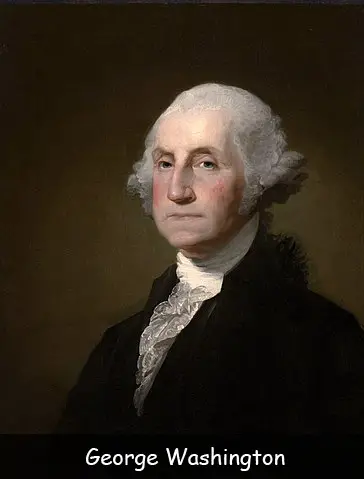
George Washington

Leader of the American Revolution. First U.S. President. Father of Our Country. George Washington earned all these titles. But who was he as a person.

Fun Facts

  • George Washington was born in Virginia in 1732. His father was a farmer. He grew tobacco and kept slaves. He was wealthy and lived like an English gentleman. He had nice clothes and nice things.
  • When George was seven, his family moved to a new farm, Ferry Farm.
  • George’s older brothers had gone to England for school, but George went to school in America. He took his schooling seriously and worked hard. He learned to write by copying rules from a book about being a gentleman. The rules were things like, “Sit not when others stand,” and “Sleep not when others speak.” He learned all 110 of the rules.
  • When he was not in school, George liked to fish, hunt and swim. He played sports and could ride a horse better than most of the other boys.
  • George’s older brother, Lawrence, came back from England where he had been a soldier. He had many exciting stories to tell.
  • When George was 11, his father died.
  • When George was a little older, he became a surveyor. It was his job to measure and map out land. George traveled all over, surveying and mapping land. He often slept in the woods and ate ducks and fish that he had caught. He liked to visit Lawrence, who lived on a farm called Mount Vernon. Lawrence often had parties and dances. George dressed in his finest to impress the ladies.
  • George was very sad when his beloved brother became ill and died.
  • George became a soldier in the French and Indian War. The French wanted the rich lands of America too. They became rich trapping and trading furs. They fought with the English over the land. The Indians helped the French.
  • George learned a valuable lesson during that war. The French and the Indians wore plain clothes. They hid behind trees to fight. The English wore bright red coats that could be seen for miles around. They marched in formation through the country. They were easy to see—and easy to hit. George learned to fight like the Indians.
  • George Washington met and married Martha Custis. She was a widow with two children. They lived happily at Mount Vernon, where George became a skilled farmer.
  • The British taxed the colonists more and more heavily. The colonists became unhappy and when it became clear that they were headed for war, they asked George Washington to lead the army. George had his work cut out for him. His little army was inexperienced and had few weapons or supplies. They fought amongst themselves.
  • Slowly George trained his men and they became a disciplined army.
  • Finally the war ended. America was free. George looked forward to going home to his farm. But who would lead the country? It was heavily in debt and people were fighting over what to do. Some people wanted a king.
  • George Washington did not think that was a good idea. He and other leaders developed the constitution. He was asked to be president. George Washington served for eight years. The people loved him. They asked him to serve for four more years.
  • George said no. He was old and tired. He said it was someone else’s turn. He returned to his farm, but only lived a few months. He caught a cold in December, 1799, and died two days later.

Learn More

Did George Washington have wooden teeth? Find out.

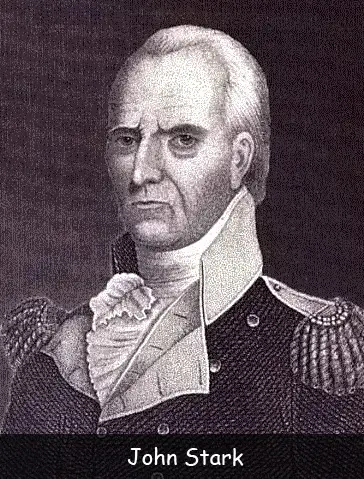
John Stark

John Stark was almost an old man when the Revolutionary War began, but he was full of patriotic spirit.

Fun Facts

  • John Stark owned a farm and sawmill in New Hampshire. When he heard about the guns fired on colonists at Lexington and Concord on April 19, 1775, he immediately gathered 400 men and marched to Massachusetts.
  • He arrived in time to fill in a gap in the line at the Battle of Bunker Hill. If his men hadn’t been there, the British might have gotten through that line and caused much more damage.
  • John was 46 years old, almost old age for that time period. He was made a general and went on to lead several battles.
  • Two years later, he stopped the British at the Battle of Bennington.
  • He said, “Live free or die; death is not the worst of evils,” which later became New Hampshire’s state motto.
  • John Stark died in 1822 at the age of 94, the last of the Revolutionary War generals.

Vocabulary

  1. Sawmill: a place where wood is milled into lumber
  2. Colonist: someone living in the colonies

Questions and Answers

Question: Did someone ask John Stark to come from New Hampshire?

Answer: It doesn’t appear so. He had fought in the French and Indian War and had military experience. He saw a need and rose to the challenge.

Learn More

Watch videos about General Stark.

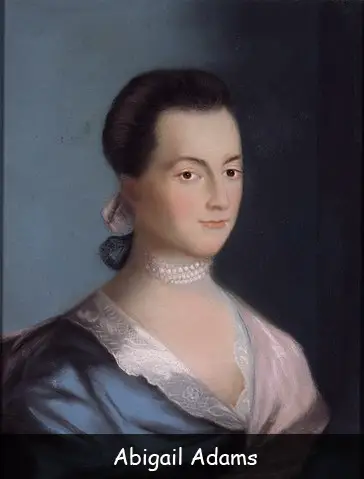
Abigail Adams

Abigail Adams was one of the founders of the American Revolution. Smart, passionate, and articulate, she supported her husband and spoke out on her own too.

Fun Facts

  • Abigail Adams was born in 1744 in Weymouth, Massachusetts, just a few miles from Boston.
  • Her parents both came from important families. Abigail’s grandfather served as the Speaker of the Massachusetts Assembly for more than 40 years. He influenced her to be active in politics.
  • Abigail was homeschooled. She taught herself by reading from books in the family library. A tutor began teaching her at home when she was eleven.
  • Abigail’s father was a minister and a farmer. Her mother cared for the home and family.
  • She was 17 when she met and fell in love with John Adams, a country lawyer and farmer. He was 26, short, chubby, and balding. The two shared the same interests and enjoyed talking to each other. They wrote long, passionate letters to each other throughout their lives.
  • They were married when Abigail was 19 and had six children, four of whom survived to adulthood.
  • Abigail encouraged her husband to speak up and to do the right thing. She was a strong force behind his political and legal career.
  • Abigail was ahead of her time in many ways. She was an outspoken advocate for women’s rights and women’s education. She did not believe in slavery.
  • She understood how important freedom was. She once said, “Is it not better to die the last of British freemen, than live the first of British slaves?”

Vocabulary

  1. Articulate: well-spoken
  2. Advocate: supporter

Questions and Answers

Question: Did Abigail enjoy being the First Lady?

Answer: Not particularly. She was criticized for being outspoken and she found it hard to bite her tongue. She was one of only two women to be both wife and mother of a president.

Her son, John Quincy Adams, later became president. Barbara Bush was also married to a U.S. president and had a son who served as president.

Learn More

Watch a video about Abigail Adams.

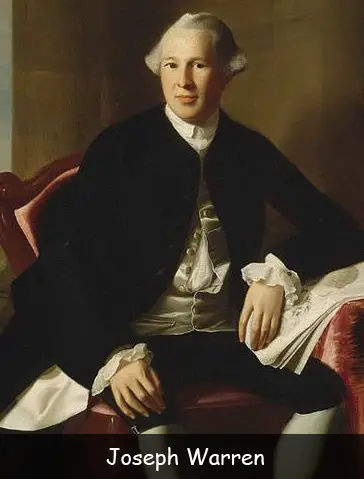
Joseph Warren

Joseph Warren was an important, but often forgotten figure in the Revolutionary War. He was a doctor, popular speaker, and grave robber.

Fun Facts

  • Joseph Warren was fourteen-years-old when he enrolled at Harvard University.
  • By age 22, he was a physician, treating prominent people in Boston, including John Adams, Samuel Adams, and John Hanco-ck.
  • He was considered the best doctor in the city. This reputation gave him access to Loyalists, including the wife of British General Thomas Gage.
  • Some people think Margaret Gage might have told him secrets about the British army’s tactics.
  • During medical school, he probably belonged to the Spunkers, a group of medical students that visited graveyards and poorhouses looking for bodies to study.
  • In 1775, Joseph Warren was asked to give a speech commemorating the Boston Massacre. He gave a rousing address and wore a toga. The British soldiers watching were not amused.
  • Warren was a free mason and was the grand master of his group. They often met at the Green Dragon Tavern to plan the revolution.
  • In response to the “Intolerable Acts,” Warren wrote the Suffolk Resolves, which basically said that the colonists would not put up with the British rules. The Continental Congress endorsed the document.
  • Warren was the one who sent Paul Revere on his famous ride.

Vocabulary

  1. Poorhouse: a place for people living in poverty
  2. Endorse: support

Questions and Answers

Question: Why isn’t Joseph Warren better known?

Answer: Warren was killed at the Battle of Bunker Hill when he was 34-years-old. Had he lived, he probably would have been a prominent Founding Father.

Learn More

Watch a video about Joseph Warren.

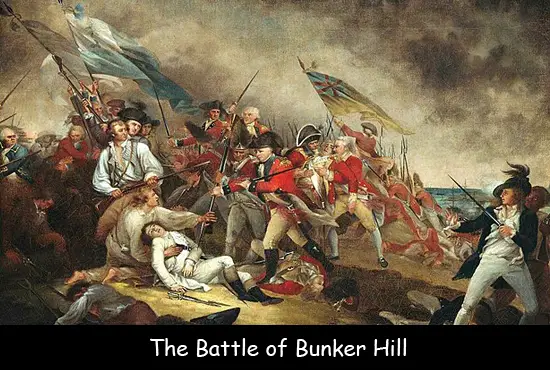
The Battle of Bunker Hill

Tensions had been escalating for weeks and the British warship Lively had been sitting in the Boston Harbor. The American militiamen had a surprise for the redcoats.

Fun Facts

  • As the sun rose on June 17, 1775, sailors on the British warship Lively were surprised. A fort stood on a hill across the Charles River. The fort had not been there the day before.
  • American militiamen had quietly worked through the night assembling the fort. They hid behind it while cannons from the ship blasted at them.
  • The redcoats crossed the river by boat and lined up in battle formation under Bunker Hill.
  • The British didn’t know it, but the Americans had very little ammunition. Some of the soldiers had stopped on their way to melt old pipes into bullets.
  • The American commander Colonel William Prescott, knowing how little ammunition they had, told the patriots to wait to shoot until they could “see the whites of their eyes.”
  • The redcoats approached the hill. No shots. They came closer. All at once, there was a barrage of gunfire. The redcoats retreated.
  • Their officers beat them with swords and forced them to go back up the hill where the Americans once again fired on them.
  • Finally, the Americans ran out of ammunition. The British charged over the walls of the fort and the patriots retreated.
  • Both sides sustained heavy losses, but the British lost almost half their men that day. Almost 1,000 British soldiers were killed or wounded.

Vocabulary

  1. Militiamen: soldiers
  2. Patriots: the colonial soldiers were sometimes called patriots
  3. Redcoat: a British soldier, named for his uniform

Questions and Answers

Question: Were all the soldiers young?

Answer: No, men of all ages fought in the Revolutionary War. American patriot, Dr. Joseph Warren, was killed during the Battle of Bunker Hill. His body was recovered a year later when the British left Boston.

Paul Revere identified it because of the two false teeth he had wired into the doctor’s mouth. John Pitcairn, a British major, died at Bunker Hill in his son’s arms.

Learn More

Watch a short video about the Battle of Bunker Hill.

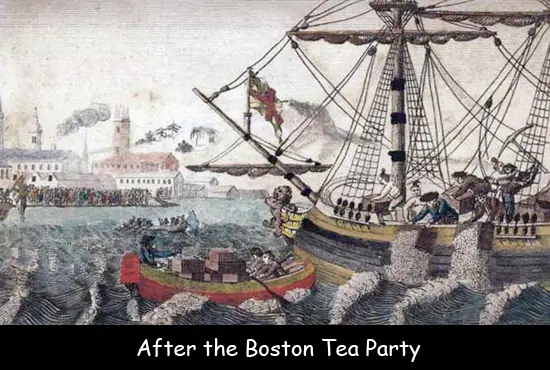
After the Boston Tea Party

King George was furious when he heard about the Boston Tea Party. Enough was enough! Parliament passed even stricter laws to punish the colonists. British leaders hoped these laws would make the colonists back down. Their ideas didn’t work.

Fun Facts

  • The colonists called the strict laws “The Intolerable Acts.” Almost 1,000 people attended a protest in Connecticut. The town executioner read a copy of the Intolerable Acts aloud and then burned it.
  • On June 1, 1774, British warships arrived in Boston Harbor, closing it to all ships. The colonists were worried. They made their living by fishing and trading on the sea. How would they get food and supplies into the city?
  • But people all over colonial America sent horsedrawn carts full of barrels of corn, wheat, rice, and fish. Farmers brought sheep, cattle, and goats. A committee decided that men must work to get a portion of the food. One of the jobs they did was to pave the streets of Boston with pavers. Visit there and you might see some of the roads they laid.
  • The people of Boston hated the redcoat soldiers and often fought with them.
  • People across the colonies were ready for war. George Washington said he would raise 1,000 men, pay for their expenses himself and march as their leader.
  • General Thomas Gage brought 4,000 redcoats to occupy Boston. He thought he would quickly defeat the colonists but he was wrong. He wrote in a letter, “If you think 10,000 men enough, send twenty; if a million is thought enough, give two.”

Vocabulary

  1. Parliament: the law-making arm of the British government, similar to our House and Senate
  2. Intolerable: horrible, not to be tolerated
  3. Paver: a brick or stone used to pave roads

Questions and Answers

Question: Were the British soldiers well-trained?

Answer: Some of them were, but not all. And they were accustomed to the European style of war, which was orderly and structured. The colonists had learned from Native Americans to fight by hiding behind trees and ambushing troops. Additionally, many of the colonists were expert marksmen who had learned to use weapons hunting game on the frontier.

One farmer watched the British soldiers firing at a target. None of the soldiers could hit it. The farmer asked for a turn and hit the target every time. He said his young son could throw an apple in the air and shoot out the seeds as the apple was coming down.

Learn More

Watch a video about the Intolerable Acts.

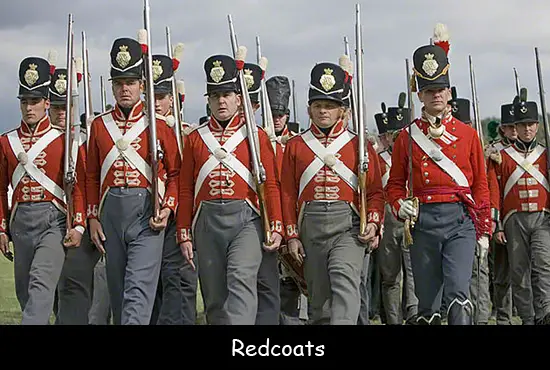
Being a Redcoat

Think being a soldier during the Revolutionary War was an exciting life? Think again. More often than not, soldiers’ lives were lonely, dangerous, and hard. Especially if you were a redcoat.

Fun Facts

  • During the American Revolution, American soldiers (patriots) were not professional soldiers. Most were farmers or tradesmen. They fought in the war because they believed in the cause. They were paid to fight, but payment was slow in coming, and couldn’t be a primary motivation.
  • British soldiers (the redcoats) were professional soldiers. Most of them had joined the army because they needed work. Some of them believed in their cause, but most didn’t really care.
  • They were called redcoats because of their red uniforms. They looked nice, but the uniforms were very uncomfortable. The jackets were made of wool. They were itchy and hot. The white pants had to be put on while they were wet because they were so tight.
  • The soldiers had to pass inspection each day. The soldiers braided their hair and powdered it with white flour. The end of the braid was dipped in animal grease. Yuck!
  • Shoes were polished, as well as buttons and buckles. Any soldier with a dirty uniform was whipped.
  • The redcoats were paid about two cents a day. To supplement their income they worked for farmers and storeowners.
  • They were unaccustomed to the rugged American frontier with its dark forests, cold climate, and hostile Indians.
  • The colonists hated them. They called them “Lobster backs” because of their red coats, taunted them, and sometimes threw things at them.
  • Sometimes the soldiers brought their families with them. Their wives cooked, cleaned, and nursed the wounded. Their children often witnessed bloody battles. Most soldiers left their families behind in England.

Vocabulary

Patriot: Colonial soldier

Redcoat: British soldier

Questions and Answers

Question: Why did the soldiers stay if life in the army was so bad?

Answer: Soldiers who left the army, or deserted, were executed if they were caught. In this situation, the soldier might stand in front of a coffin while a firing squad shot at him.

Fear of punishment was a good reason to stay. Just the same, some escaped and joined the American army, even helping train the men. The American army said it had better pay, better food, and better conditions.

Learn More

Watch a video about how the American army tried to convince British soldiers to come to its side.