All posts by americanadmin

Molly Pitcher

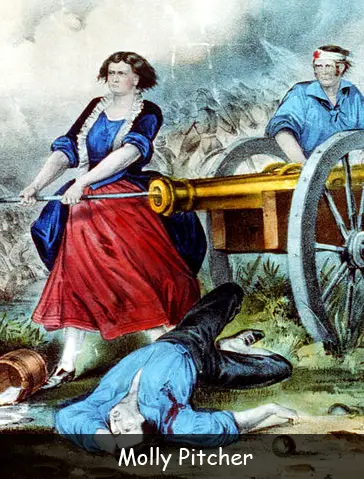
Few women worked as soldiers during the Revolutionary War, but they did work as nurses and cooks. Mary Ludwig was one of those women. That is, until her husband collapsed in battle and she picked up his gun.

Fun Facts

  • Molly Pitcher’s real name was Mary Ludwig. She was born in 1754.
  • When she was 13, she married William Hays and began working as a servant.
  • When William enlisted in the army, she went along. During the Battle of Monmouth, she delivered pitchers of water from a nearby stream to the exhausted soldiers. The day was hot and William collapsed on the battlefield from heat stroke.
  • Molly picked up his gun and continued fighting for the rest of the battle. According to one account, a cannonball flew through the bottom of her skirt, ripping away her petticoat but leaving her unharmed.
  • Molly, whose real name was Mary, was given the nickname ‘Molly Pitcher’ for her bravery that day.
  • One story says that George Washington saw her on the battlefield that day and gave her a commendation.
  • After the war, Molly became a servant and charwoman again.
  • She was given a military pension in 1822 and a special marker was added to her gravestone in 1876.

Vocabulary

  1. Heat stroke: a serious illness brought on by heat
  2. Charwoman: a woman who cleans houses and office buildings

Questions and Answers

Question: How do we know about Molly Pitcher?

Answer: A recorded account of Molly Pitcher’s adventure was discovered during the 1950s. Written by soldier, Joseph Plumb Martin, the journals describe his experiences.

But other stories have been handed down through families although they weren’t written down. It’s hard to say if all the stories are true or if some have been exaggerated.

Learn More

Watch a video about Molly Pitcher.
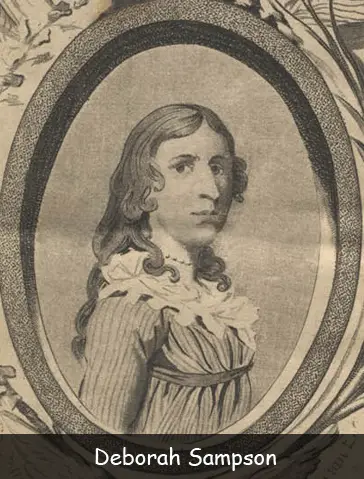
Deborah Sampson

Move over Mulan. Meet a real woman disguised as a male soldier. Deborah Sampson fought in the Revolutionary War for two years before her gender was discovered.


Fun Facts

  • Deborah Sampson was born in 1760 in Plimpton, Massachusetts. Her parents were direct descendants of important Pilgrims, William Bradford, first governor of Massachusetts, Myles Standish, and Priscilla Alden.
  • In spite of her family’s social standing, Deborah’s parents struggled financially. Her father went off to sea never to return, leaving Deborah’s mother to support seven children.
  • Deborah’s mother had to separate the children, sending each to live with a different relative. When Deborah was 10, she was sent to work as a servant in a farmer’s home. There she helped care for the house and the children.
  • She left when she was 18. She’d never attended school but had educated herself by reading whatever books she could find. She became a teacher, as well as a weaver.
  • Deborah was very patriotic and wanted to help the cause. In 1782, she dressed as a man and enlisted in the Revolutionary War. For the next two years, she often led small parties of men to scout out areas, which was a bit like spying. George Washington wanted her to find out where the British troops were and what they were doing.
  • Fighting often broke out if they encountered British soldiers. She had a few close calls. In one fight, her head was slashed open by a sword. Another time, she was shot in the thigh. She dug out the pistol ball by herself.
  • Finally her gender became known when she was taken to a hospital unconscious during an illness. She begged the doctor not to give away her secret and he agreed.
  • Deborah Sampson was the only woman to receive a military pension for fighting in the Revolutionary War. She was also honored with a statue.


Vocabulary

  1. Descendant: The children, grandchildren, etc. descended from someone
  2. Social standing: One’s place in society; Deborah enjoyed high social standing because of her important ancestors
  3. Pistol Ball: a lead ball used as an early bullet


Questions and Answers

Question: What happened to Deborah after the war?

Answer: She married Benjamin Gannet, a farmer, and they had three children. Her time in the army must have given her enough excitement, because the rest of her life was quiet.

She helped her husband with their farm and raised her children. She did go on a lecture tour, talking about her adventures, and a book was published about her life in 1797.


Learn More

Watch a video about Deborah Sampson.

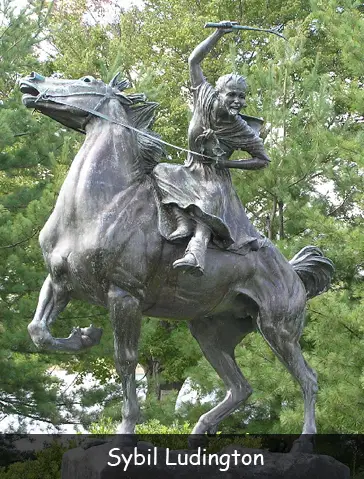
Sybil Ludington

Colonial women didn’t usually fight in the Revolutionary War, but many of them tried to do their part. Sybil Ludington was only sixteen years old when her turn came.

Fun Facts

  • A messenger arrived on horseback at the home of Colonel Henry Ludington on the night of April 26, 1777. He relayed a message that the British were planning to attack Danbury, Connecticut the next day.
  • The colonel wasn’t available to help. Instead, his daughter, Sybil, traveled through the night on her horse to alert her father’s troops. Most of the soldiers were farmers and they had disbanded to go home and plant spring crops.
  • Sybil rode between 20 and 40 miles through rain and dark woods.
  • She was able to gather several hundred soldiers.
  • The soldiers were late in getting to Danbury. The British burned the city, but they met with a fierce fight as they were leaving.
  • Sybil was the oldest of twelve children. Her father was a farmer and a military man.
  • A few years later, Sybil married and moved to the Catskills in New York. After her husband died, she purchased a tavern and raised her son by herself.
  • As an old woman, Sybil applied for a military widow’s pension, but was denied. She died in poverty. In 1975, the U.S. Postal Service honored her with her own stamp. There is a statue of her in Carmel, New York.

Vocabulary

  1. Disband: separate
  2. Deny: refuse

Questions and Answers

Question: Was Sybil’s journey dangerous?

Answer: Yes, especially for a woman. The night of her adventure was dark, cold, and rainy. She rode on rough country roads and trails. At that time, bandits were often about at night. Some records show that Sybil beat one of these bandits off with a stick when he tried to attack her.

Learn More

Watch a video about Sybil.

Taxes, Taxes, Taxes!

The French and English both wanted to stake a claim in North America. French soldiers aided native people in a war against the colonists; the English sent soldiers to protect them. This war, The French and Indian War, lasted for almost 10 years. Although the English and the colonists ultimately won the war, victory came at a heavy financial price. And, the English were worried about other wars. They decided to keep troops in the colonies indefinitely. Paying for the war—and feeding, housing, and clothing the troops—was expensive.

Who would pay for it? The British decided that the colonists should foot the bill. The colonists did not agree.

Fun Facts

First the British Parliament passed the Quartering Act, which said that colonists must give soldiers (known as redcoats) food and shelter.
Next, the British enforced the Navigation Acts, which was passed in the 1600s, but never used. This act said that the colonists had to buy everything from Britain and could only sell their products to Britain—even if they could get better prices and products elsewhere. To get around this law, the colonists hired smugglers to sneak products in and out of the country.
Then the British government enacted the Sugar Act, which made buying sugar very expensive.
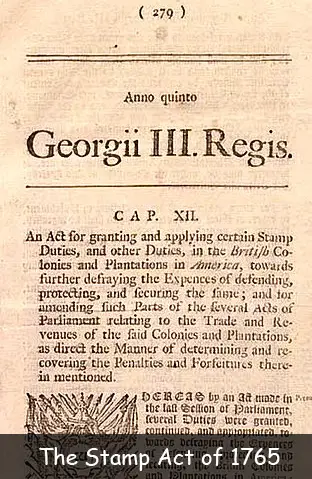
The Stamp Act of 1765 made the colonists really mad! Every piece of paper, including newspapers, marriage licenses, wills, land deeds, and diplomas, had to have a British stamp (paid for by the colonists) to be considered legal.
The colonists were so angry about the Stamp Act that they rioted in the streets. They threw rocks through the windows of the home where the stamp tax collector lived. They made an effigy of the tax collector for Massachusetts, Andrew Oliver, and hung it in a tree. Finally, the British government repealed the Stamp Act.
In 1767, Parliament passed the Townshend Acts, which placed high taxes on tea and cloth. The colonists revolted again, refusing to buy British goods. They quit drinking tea and drank coffee instead. The women made clothing from rough homespun fabric. If someone was found buying British goods, they risked being tarred and feathered.
Vocabulary

Enact: pass or put into action
Effigy: a model or doll made to represent someone
Repeal: Remove or end
Questions and Answers

Question: What does it mean to be tarred and feathered?

Answer: Tarring and feathering was a brutal punishment. The assailants stripped their victims’ clothes and poured hot tar and feathers over them. The feathers stuck to the tar and drew blood when they were pulled off the skin.

Learn More

Watch a video about the Intolerable Act.

Donald Trump Becomes President

President Obama was elected in 2008 and went on to serve two terms, beating out Mitt Romney in the 2012 election. In the 2016 election, Hilary Clinton ran against Donald Trump. Hilary Clinton, President Bill Clinton’s wife, had a long history of political experience. She had served as Secretary of State and a Senator for New York State. But, many people had not forgotten the moral and ethical scandals of her husband’s presidency. Hilary Clinton had her own political scandals and alienated many people with her hardline approach to abortion, gun control, and other controversial issues.

Donald Trump emerged as the Republican candidate, although many Republicans disliked him. He had no political experience and was a businessman of questionable moral and ethical character. The entire country, including most Republicans, was surprised when he won the 2016 election.

Fun Facts

  • During the 2016 election, the Republican Party lacked unity and organization. Never before had Republicans across the country been so divided. Some ultra-conservatives favored strict immigration laws and wanted to get rid of universal health care.
  • Other Republicans favored a more moderate approach. Many Republicans disliked Trump’s tough talk and seeming lack of compassion and restraint. Mormons, who generally voted Republican, were among his strongest critics. Many Mormons and other Republicans refused to vote or voted for third party candidates.
  • The election was one of the nastiest in recent years. Friends and family members had heated discussions about which candidate to vote for. People got into debates on Facebook.
  • Most people assumed Hillary Clinton would win. The country was surprised and shocked as the results came in. Donald Trump had won the election. In the weeks after Trump’s election, Democrats were scared and saddened. They wondered what would happen next.

Vocabulary

  1. Ethical: relating to ethics, or reasonable, right, and fair behavior
  2. Moderate: reasonable, not extreme
  3. Restraint: self-discipline, thoughtfulness

Questions and Answers

Question: What will Donald Trump’s legacy be?

Answer: It’s too soon to say at the time of this writing. He has reversed many of Obama Barack’s environmental regulations and is talking about building a wall between Mexico and the U.S. to reduce the problem of illegal immigration. His attempts to ban immigrants from Muslim countries from coming to the U.S. have been highly controversial.

Learn More

Visit Wikipedia to learn more about Donald Trump.

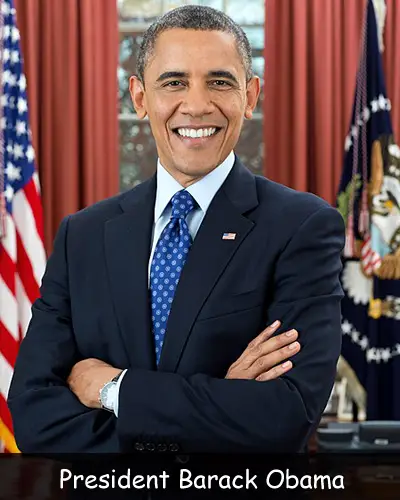
President Obama: America’s First African-American President

George W. Bush’s presidential campaign promised “compassionate conservativism.” He promised to lower taxes while caring for the poor and needy. He wanted to reduce government regulations and ensure individual freedoms. His agenda changed after 9/11 though. Crushing terrorism became a major concern. Bush remained a popular president and won a second term. As the war against terrorism dragged on with little success, Americans began to grow weary. Bush’s tax cuts drove up the federal deficit and the nation headed into a recession.

In 2008, Democrat Barack Obama defeated presidential candidate, John McCain, to become the first African-American president in America’s history. Obama was young, charismatic, and well-educated. He promised quick action to restore the nation’s economy.

Fun Facts

  • Obama made several changes to boost the economy. He lowered interest rates to encourage Americans to get loans and offered programs to help Americans who already owned homes.
  • One of Obama’s most controversial moves was the Affordable Healthcare Act, which promised health insurance to all Americans.
  • Liberals appreciated Obama’s views on abortion, gay rights, and the environment. Conservatives disagreed with many of his values and worried that he was destroying individual liberties, and in particular, religious freedom.
  • Terrorism continued to be a problem throughout Barack Obama’s presidency. Some people felt that he didn’t do enough to quell rising terrorism.

Vocabulary

  1. Agenda: plan
  2. Weary: tired
  3. Deficit: amount one owes

Questions and Answers

Question: Did the economy improve during President Obama’s term in office?

Answer: Most people would agree that the economy did improve during Obama’s presidency.

Learn More

Visit Wikipedia to learn more about President Barack Obama.

The Great Recession 2007-2009

The terrorist attacks on 9/11 took a toll on U.S. industries. The stock market plummeted in the days following the attacks. Airlines struggled to avoid bankruptcy as Americans, leery of airline travel, cancelled their travel plans.

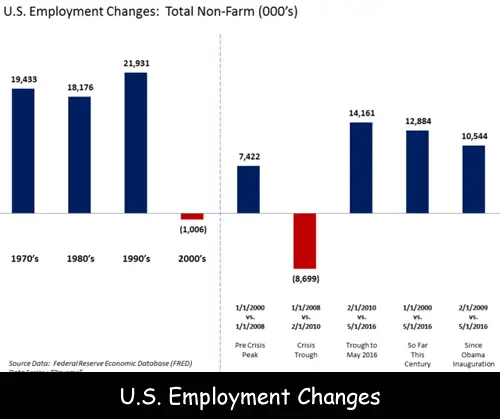
The economy recovered quickly, though. Low interest rates and lax lending rules made it easy for people to buy homes. Many people bought larger, more expensive houses than they could really afford. Home builders built more houses than they could sell. House prices rose quickly. Growth slowed and housing prices dropped. It was the beginning of the Great Recession (2008 to , the worst economic downturn since the stock market crash of 1929 and the Great Depression.

Fun Facts

  • Many Americans lost their jobs because companies could no longer afford to keep them. At the same time, Americans carried more credit card debt and other debt than ever before. They couldn’t afford to pay the mortgages on their homes.
  • If someone couldn’t pay his mortgage, the banks could foreclose on the home – or take it back from the owner. In 2007, almost 1.3 million people lost their homes. Banks tried to resell the homes, but often had to lower the price or let the home sit on the market for many months.
  • Home values in many parts of the country had risen quickly during the early part of the 21st During the recession, home values went down. People often owed more on their homes than they were worth.
  • As people lost confidence in the economy, they stopped spending. The value of the stock market went down. Many people lost their investments during this time. Older people who were retired or almost retired were particularly hard hit.
  • Banks lost money and went bankrupt. The Federal Government bailed out many banks and also helped U.S. carmakers. Obama approved money to build infrastructures, such as roads and bridges. This money meant new jobs.
  • The recession spread to Europe and then to many parts of the world.
  • Although Obama said that the markets were stabilized and the recession was over in 2010, many people were still rebuilding their lives several years later.

Vocabulary

  1. Bankrupt: when a company or individual is unable to pay its bills
  2. Foreclose: when a bank takes back property, such as a home, because the owner doesn’t pay the loan payments
  3. Infrastructure: the underlying elements of a society, such as roads, bridges, and pipes

Questions and Answers

Question: How can we prevent another recession?

Answer: The economy tends to grow and shrink in cycles that can’t always be predicted or prevented. Government and industries can help by keeping a healthy balance of regulation and not taking foolish risks. Individuals can be prepared for hard times by avoiding debt and living within their means.

Learn More

Visit The State of Working America to read more about the Great Recession.

Guns in America

Gun control has always been a hot topic in the U.S. Early colonists relied on their guns for both hunting and protection. Had they not had guns, they would have had a difficult time winning the Revolutionary War. After the war, most Americans fiercely defended the right to keep guns. As Americans moved west, they relied on their guns again for protection and to hunt game.

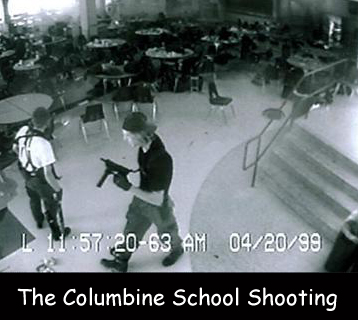
After the Columbine school shootings in 1998, many people began talking about the need for stronger gun laws. During the 21st century, gun laws became a bigger concern because of several mass shootings. Although the laws vary from state to state, most states require gun owners to pass a background check and register to own a gun. States also have restrictions on the types and numbers of guns one can own.

Fun Facts

  • On December 14, 2012, Adam Lanza entered Sandy Hooks Elementary School in Newtown, Connecticut. He shot and killed 20 young children, the principal, and six staff members. Lanza killed his mother earlier in the morning. He killed himself as police officers arrived at the school.
  • On November 29, 2015, a gunman entered a Planned Parenthood center in Colorado Springs, Colorado, killing three and injuring 9. He was angry over the center’s abortion activities.
  • In October, 2015, Sean Harper-Mercer shot and killed eight students and a teacher at Umpqua Community College, where he was attending school. Harper-Mercer was a white supremacist who hated religion and people of color.
  • In June, 2016, a gunman killed 50 people and injured 53 at a gay nightclub in Orlando, Florida.
  • In the instances listed above, the gunmen or women often suffered from mental illness. Sometimes these people are angry at a certain group because they disagree with or feel threatened by that group’s values.
  • Most gun-related injuries are accidental or occur in small fights between people who know each other.

Vocabulary

  1. Restriction: a law or limit
  2. White supremacist: someone who believes that white people are superior to other races and may use violence to make his or her point
  3. Lenient: relaxed; not strict

Questions and Answers

Question: How can I stay safe with guns?

Answer: It’s important to know that not every person who owns a gun is a bad guy. Many good people own guns, including police officers and hunters. These people understand guns’ power and treat them with respect. If you see a gun, even if you think it might be a play gun, do not touch it. Leave the area and tell a grownup. If a friend tells you he or she has a gun, leave and tell an adult.

Question: Do stricter gun laws work?

Answer: Probably. Some of the states with the strictest gun rules, such as New York, Rhode Island, and Massachusetts, also have the fewest incidences of gun violence.

Learn More

Visit Kids’ Health to learn more about gun safety.

Culture and Lifestyles in the 21st Century

The first part of the 21st century marks rapid changes in social values, similar to the changes that occurred in the first part of the 20th century. Families become more diverse. For the first time in history, large groups of people opt not to get married or have children. Technology makes entertainment and news even more accessible.

  • Mobile devices, such as cell phones and tablets, act almost like handheld computers. People use cell phones, not only to call each other, but to text, shop, get directions, take photos, keep notes, make videos, read books, listen to music, and even watch movies. These devices are tremendously helpful, but they can sometimes be a distraction. Accidents happen when people try to drive while using mobile devices. Cell phones and tablets can be addictive and interfere with face-to-face conversations. They also allow easy access to harmful content, such as pornography or violence.
  • Video games are a favorite form of entertainment. Children and adults spend a lot of time playing these games.
  • Education is changing. Many public school districts offer charter schools. Each charter school has a different educational focus. Some schools might focus on science, while another might focus on the arts. Parents and children can choose which school to attend. Homeschooling is a growing movement, with over 3 million children learning at home in 2013. More and more families are expected to homeschool in the future.

  • As families become more affluent, many of them travel more. Expensive vacations, including cruises and trips to Disneyworld, Europe, or the tropics, are much more common. Some families, especially homeschooling families, travel the world as a means of education.
  • Cultural values shift. Gay marriage is legalized and gay and lesbian people lobby for fair treatment. The idea of ‘gender fluidity’ emerges, which says that gender can change or encompass both male and female. Many people oppose this idea, including religious leaders, scientists, and doctors.
  • Religious tensions increase as traditional Christians oppose abortion rights and gay marriage. Non-religious people view Christians as narrow-minded or prejudiced. Many Christians feel that they are losing their right to speak freely about their beliefs. Debates over religious freedom are common.
  • Racial tensions heat up as white supremacist groups become more vocal. African-Americans rioted and protested against police violence. Several shootings in churches and public places targeted African-Americans.
  • Social media platforms, such as Facebook, become a primary way for people to communicate and share news. Companies use social media to advertise their products. Politicians use social media to gain political favor.

Vocabulary

  1. Accessible: easy to get
  2. Affluent: wealthy
  3. Fluidity: changeable


Questions and Answers

Question: How can I use technology wisely?

Answer: Great question. First, understand that just as your body needs nutritious food to be healthy, your mind needs good material to remain healthy too. Watching or listening to content that is violent and degrading can cause damage. Talk with your parents about how to choose wholesome music, videos, and video games. If you encounter pornography or violent images, turn it off and tell your parents.

Second, keep a balance in your life. Technology can be a wonderful way to learn new things, but it shouldn’t take the place of other activities. Make sure you play outside every day. Try to eat dinner with your family several times each week. Read books and participate in face-to-face conversations.

Learn More

Check out an infographic about children and technology.

Responding to 9/11

After the terrorist attacks on the World Trade Center, rescue workers searched through the debris to find survivors, as well as the bodies of those who were killed. Sixteen acres of New York’s business district was covered with ash. Crews came in to begin cleaning away the rubble. In Washington, D.C., President Bush and other leaders took a hard stance against the terrorists.

Fun Facts

  • Intelligence sources quickly traced the attacks to Osama bin Laden, a Saudi Multimillionaire. Bin Laden was the leader of an international group called Al Qaeda. This group had organized other terrorist attacks, such as the 1993 attacks on the World Trade Center and the 1998 attacks on U.S. embassies.
  • Bin Laden wanted to start a jihad, or holy war, against the U.S. He said he planned to “kill Americans and plunder their money.”
  • An extremist Muslim group – the Taliban – supported and protected bin Laden, who was hiding in Afghanistan.
  • American leaders asked the Taliban to turn bin Laden over to them. When the Taliban refused, America, Britain, and several other nations launched air attacks on Taliban strongholds. Neighboring Pakistan aided the allies. Afghan troops launched ground attacks against the Taliban and were joined in December, 2001, by U.S. ground troops.
  • The fight took troops into the mountains and caves of Afghanistan, searching for bin Laden.
  • Additionally, the U.S. asked other governments to freeze the financial assets of all terrorist groups. Without access to their money, terrorist groups couldn’t function.
  • In 2002, President Bush’s administration tried to build an international coalition to shut down terrorist groups around the world. At first, their plans seemed to be going well, but several Arab countries refused to cooperate. These countries were unhappy with America’s support of Israel.
  • The government developed much stricter regulations for airline travel.

Vocabulary

  1. Coalition: when unrelated groups come together to support and act on a particular issue, often temporarily
  2. Plunder: to steal by force, usually during a time of war
  3. Extremist: someone with extreme religious or political views

Questions and Answers

Question: Was the war on terrorism successful?

Answer: Not particularly. Fighting terrorists is different from fighting more traditional opponents. Terrorists don’t care if they die and they generally don’t have clear goals, other than causing destruction. Terrorism is still a problem today.

Learn More

The Twin Towers were not rebuilt after the attacks. Instead, a memorial and park were built there. Learn more about visiting it.