
• Tag Archives: all about World War II

    The 1950s: Peace and Prosperity

    The end of World War II brought new financial opportunities to many American families. During the war, men and women had been paid high wages working in factories and other industries. They saved most of the money they earned during the war and were now ready to spend.

    Television advertisements introduced Americans to new, exciting products. People had more time for entertainment, and after the hard years of the Great Depression and World War II, they were ready to relax.
    Fun Facts

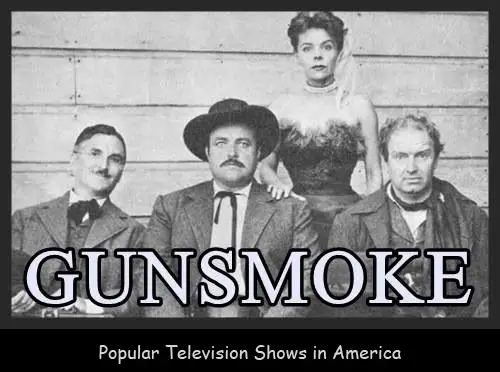
    • Television became a huge influence during the 1950s. Almost every family owned a television set and enjoyed watching programs like Gunsmoke, I Love Lucy, and Leave It to Beaver. Television shows influenced popular culture more than almost anything else.
    • When soldiers came home from the war and started families, they had a hard time finding homes. A housing shortage spurred a huge building trend. Thousands of Americans left the cities and country to move to suburbs, small neighborhoods near the edge of larger cities.
    • For many years, debt was seen as a bad thing. In the 1950s, using credit to make purchases became more acceptable. The GI Bill gave veterans low-interest loans to buy houses or go to college.
    • Fads developed and spread quickly through television commercials. Barbies became popular toys that children still play with today. Hula hoops, bubble gum, and coonskin caps were other fads of the 1950s. Girls began wearing blue jeans and ponytails. Boys wore blue jeans with white t-shirts.
    • Teenagers loved listening and dancing to the new music, “rock and roll.” Singers like Elvis Presley, Debbie Reynolds, and Pat Boone rose to stardom. People loved going to drive-in movie theaters, as well as indoor theaters. The Sound of Music was a favorite movie.

    Vocabulary

    1. Fad: something that becomes very popular and then usually fades away
    2. Suburb: neighborhoods that lie in between rural areas and larger cities
    3. Veteran: someone who has served in the military

    Questions and Answers

    Question: Were the 1950s a peaceful time?

    Answer: Most people view the 1950s as a peaceful, idyllic time. More people than ever before could afford a new home and car (the American Dream). Their children played in safe neighborhoods and went to new schools. It was a time of great growth for America. During the 1950s, people were very interested in science too. This interest fueled new innovations, but also trickled down to everyday life. For example, women became very interested in using packaged, scientific food products, such as cake mixes, gelatin, and frozen dinners.
    The Vietnam War

    In the late 1800s, the area that is now Vietnam was colonized by France and called French Indochina. It remained under French control for many years, but in 1945, Communist leader Ho Chi Minh defeated the French. The country was divided into two parts: North and South Vietnam.

    After World War II, Communism spread through much of Eastern Europe and Asia. American leaders viewed Communism as a threat to freedom and democracy and wanted to contain its growth. They did not want Communist North Vietnam to take over South Vietnam, further enlarging Communist territory. In the 1950s, the U.S. began sending money and providing military training to South Vietnam.

    In 1964, President Johnson asked Congress to approve a resolution that would allow him to take more aggressive action against Vietnam. This resolution led to U.S. involvement in the Vietnam War.

    Fun Facts:

    • President Johnson’s request for a resolution came after reports that North Vietnamese gunboats had fired on two U.S. destroyers.
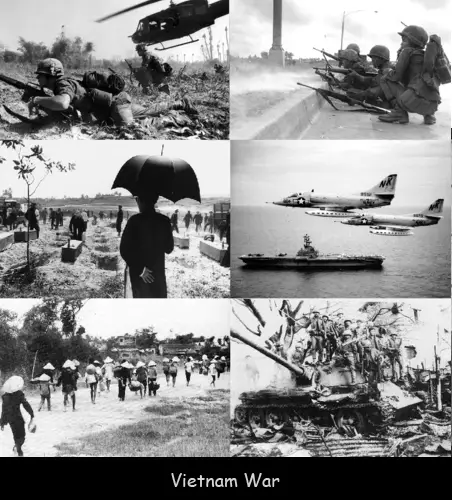
    • Fighting in Vietnam was nothing like fighting in Europe during World War II. Dense jungles, mosquitoes, heat, and malaria made progress difficult. Enemy Viet Cong soldiers could hide in villages, attack, and disappear. Fields were full of booby traps and mines and hundreds of miles of tunnels ran under villages, allowing enemy soldiers to escape quickly.
    • Americans were deeply divided over the war. Some thought it was necessary, believing that if the Viet Cong won, Communism would spread to Cambodia and Laos. Others believed the war was too difficult to win and the sacrifices were too great. Thousands of American soldiers died and many innocent civilians were killed in Vietnam by American bombs.
    • In January, 1968, the Viet Cong launched an attack on the U.S. Embassy in Saigon, several American bases, and 36 cities in South Vietnam. Soon after, President Johnson announced an end to American bombing in Vietnam.
    • Before the end of his presidency, President Johnson had started peace talks with the Viet Cong. President Nixon continued these talks in Paris, but at the same time, he launched secret bombing campaigns in Cambodia. His goal was to stop the North Vietnamese from delivering weapons and men through Cambodia to South Vietnam.
    • Nixon had ordered the withdrawal of 25,000 U.S. troops from Vietnam in June of 1969. When Communist troops threatened to take over Cambodia, Nixon ordered troops to invade that country. At home, anti-war sentiments increased. In 1971, more than 200,000 protesters marched in Washington, D.C.
    • By 1972, troops, politicians, and the American public were disheartened. Victory against the Viet Cong seemed impossible. In January, 1973, American leaders and the Viet Cong signed the Paris Peace Accords. All U.S. forces left Vietnam and more than 500 American prisoners of war were released.
    • In March, 1975, the Communists broke their peace truce, attacking cities throughout South Vietnam. Millions of refugees fled and the few remaining American troops and government workers were evacuated by helicopter. America had lost the war and the Communists had complete control of Vietnam.

    Vocabulary:

    1. Mine: an explosive device buried in the soil that goes off when disturbed
    2. Truce: an agreement of peace

    Questions and Answers:

    Question: What happened after the Vietnam War?

    Answer: After World War II, troops received a hero’s welcome home. After Vietnam, troops were often blamed or humiliated for not winning the war. Many soldiers had been tortured or endured horrible experiences. They suffered from “post-traumatic stress disorder.” Some used drugs and alcohol to forget. Others had difficulty finding jobs. Some committed suicide.

    At the same time, the American people felt confused, betrayed, and angry. They began to distrust their leaders, a problem that continues today. They were horrified to learn of American soldiers killing innocent women and children in Vietnam. One example is the My Lai massacre. Troops opened fire on a Vietnamese village believed to be held by Communists. At least 400 villagers were killed.

    Learn More

    Visit KidsConnect for lesson plans about the Vietnam War.

    World War II: The Beginnings

    World War I plunged Europe into crisis. Many buildings and homes had been destroyed. Jobs were scarce and both governments and individuals were without money. Many people were looking for a strong leader to solve their problems. This turned out to be a mistake as corrupt and violent men were allowed to gain power.

    World War II: The Beginnings

    Fun Facts

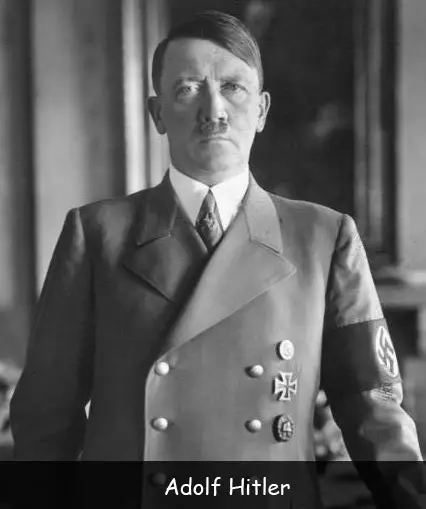
    • Adolf Hitler was elected as chancellor of Germany in 1933. He blamed the Jewish people for the country’s hardships. He quickly took dictatorial power.
    • Hitler believed that purebred, or Aryan, Germans were superior to other races, particularly Jews. In 1938, the government organized Kristallnacht, which means, “the night of broken glass.” On this night, mobs set synagogues on fire and smashed windows in the homes and businesses of Jewish people. Hundreds of people were killed; approximately 20,000 Jews were sent to concentration camps.
    • The Na-zi government organized ghettoes, crowded places in the cities that were closed off. Jews were forced to live in the ghettoes where they were watched and intimidated by Na-zi soldiers. All Jews age six and older were required to wear a yellow star with the word, “Jude,’ on it, which means Jew in German.
    • At the same time, Benito Mussolini marched his private army into Rome where he overthrew the government and became a fascist dictator. In Japan, General Hideki Tojo was rising to power.
    • Leaders in these three countries wanted to dominate and conquer the world. Together, the countries of Germany, Italy, and Japan became known as the Axis Alliance.
    • The United States had not joined the League of Nations after World War I and had a policy of neutrality. American leaders did not want to get involved in another European war. Although they expressed protest over the actions of leaders in the three countries, they did not make a stronger statement. President Roosevelt warned Congress and the American people that it would be impossible to remain neutral.
    • Hitler invaded and took over Austria in March, 1938. That fall, Germany took over the Sudeten region of Czechoslovakia, promising British and French leaders that that would be his last conquest. He broke his promise only six months later, taking over the rest of the country.
    • In September, 1939, German tanks, soldiers, and fighter planes moved into Poland. France and Great Britain declared war on Germany two days later.
    • Soon, Germany had invaded and conquered Denmark, Norway, the Netherlands, Belgium, and Luxembourg. The Na-zis seemed unstoppable.

    Vocabulary

    1. Dictator: a leader who governs the country with absolute power, often using violence and intimidation
    2. Synagogue: a Jewish place of worship
    3. Concentration camp: an organized camp where Jews and others were sent to work; the prisoners were harshly treated and many were killed.

    Questions and Answers

    Question:Could the allies have stopped the war if they had gotten involved more quickly?

    Answer: Great Britain, France, and America were slow to use force to stop Hitler and his Na-zi forces. The destruction of World War I was fresh in their minds and they wanted peace. Still, many people believe that the war could have been prevented if Allied leaders had showed greater strength sooner.

    Learn More

    Visit the Imperial War Museums to learn about the rescue at Dunkirk. German troops rolled through France in May of 1940, trapping French, British, and Belgium soldiers at Dunkirk. Hundreds of British people crossed the English Channel to rescue over 340,000 troops. The British bravely came in fishing boats, tugboats, and yachts while German submarines and fighter planes lurked nearby.
