• Tag Archives: civil war

    America’s Centennial

    General Lee’s surrender at Appomattox marked the official end of the Civil War, but it didn’t mean an end to the nation’s troubles. Bitter disagreements about how the South should rejoin the nation followed.

    As America’s Centennial (100 years as a nation) approached, people were glad for a reason to celebrate. President Ulysses S. Grant opened the Exposition in May 10, 1876 in Philadelphia, Pennsylvania. The exposition was the first world’s fair and ran through November of 1876. Ten million visitors came to the exposition, which offered renewed hope for the country’s future at a time when many people felt discouraged.
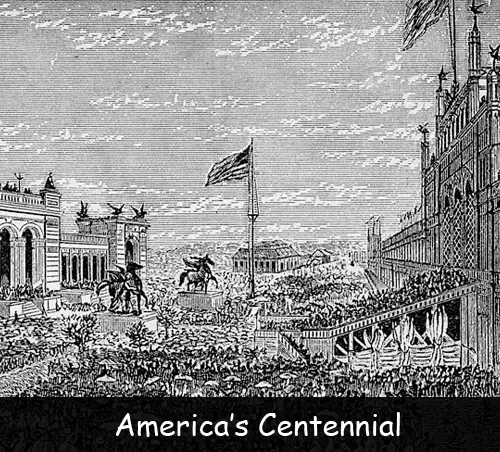
    americas-centennial

    Fun Facts

    • The Centennial Exposition took over 10 years to plan.
    • A giant Corliss steam engine was a highlight of the show. It quietly powered all the machinery in Machinery Hall.
    • Alexander Graham Bell exhibited a machine that would allow people to talk to one another from a distance through a wire – the first telephone.
    • Over 300 Native Americans participated in an exhibit that educated visitors on the Native American way of life. Many of them camped at the exposition.
    • Exhibits showcasing America’s natural resources included rocks and gems, as well as preserved animals, such as a 15-foot walrus, a polar bear, sharks, and stingrays. These displays were provided by the Smithsonian Institution.
    • Exhibits from around the world arrived for display. When the exposition was over, people wondered what to do with all the exhibits. Many of the exhibits were permanently stored at the Smithsonian Institution. They were brought out and shared again during America’s Bicentennial (200 year anniversary) in 1976.

    Vocabulary

    1. Exhibit: a display, usually educational
    2. Natural resource: something useful found in nature

    Learn More

    View some images from the Centennial Exposition.
    The Reconstruction Years

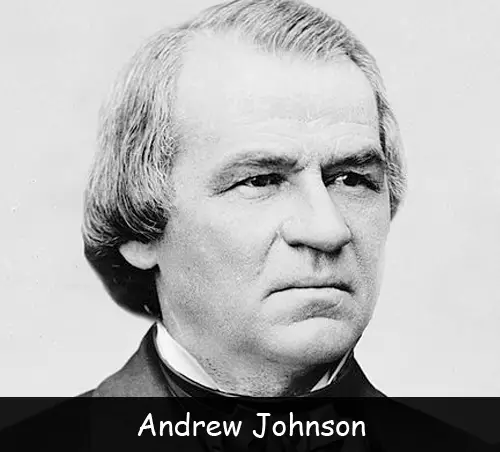
    At the end of the Civil War, America was bitterly divided. In his second inaugural address, President Lincoln asked Americans to “bind up the nation’s wounds.” He hoped Americans would forgive each other and work for peace. After Lincoln’s assassination, Vice President Andrew Johnson became President. He also wanted to help the South rejoin the Union; heIp wanted to help freed slaves.

    The Republican Congress disagreed. They wanted harsh terms for the South. They insisted on dividing the South into five military areas and placing Northern army officers over those areas. When Johnson disagreed, Congress tried to impeach him. Southerners were deeply angered and humiliated to have Northerners in charge of them.

    andrew-johnson

    Fun Facts

    • The Fourteenth Amendment guaranteed citizenship to freed slaves, known as freedmen. The Fifteenth Amendment guaranteed their right to vote. The Freedman’s Bureau was a government agency formed to help freed slaves adjust to their new life. The Freedman’s Bureau opened more than 4,000 schools.
    • In spite of this help, life for freed slaves was very hard. Most of them could not read or write. They had no property. Many people discriminated against them. Some freedmen became tenant farmers, renting land to grow crops. Others became sharecroppers. They borrowed money for land, seed, and tools and then had to repay the lender at harvest time. Unfortunately, they rarely earned enough to pay their debt and have enough money left over to pay for the next season’s seed and land.
    • Many Southerners believed in the idea of “white supremacy,” that they were morally and intellectually superior to freed slaves. Some joined secret groups like the Klu Klux Klan or KKK. This group wore hooded robes and terrorized freed slaves and anyone who tried to help them. They burned houses and barns and even killed people.
    • Southerners hated scalawags, their name for white Southerners who voted Republican or tried to help freedmen. They also despised carpetbaggers, white people who came to the South to help with the Reconstruction. These people carried bags made from leather and carpet, hence the name. Southerners believed carpetbaggers came to the South with no real desire to help, but for their own financial gain.

    Vocabulary

    1. Impeach: to attempt to remove a political officer from duty by vote
    2. Citizenship: to become a citizen of a country and be entitled to specific rights and protections
    3. Sharecropper: a farmer who doesn’t own his own land, tools, or seeds, but must borrow money from a lender

    Learn More

    Visit Encyclopedia Brittanica to learn more.

    Lincoln’s Assassination

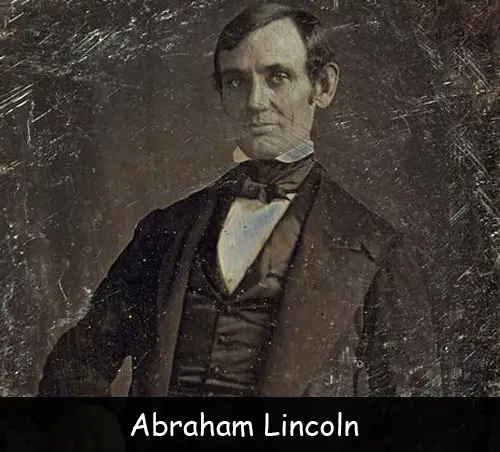
    As the Civil War ended, Lincoln pleaded with Americans to be gentle with each other and to work toward peace. This was not to be so. Five days after General Lee surrendered at Appomattox, President Lincoln attended a play at Ford’s Theater in Washington D.C. At 10:15, John Wilkes Booth, an actor and a loyal Confederate supporter, entered the theater and shot Lincoln. Lincoln’s death not only saddened Americans, but angered and frightened them. Southern sympathizers were distrusted and Congress demanded harsh terms as the South reentered the Union. The years after the Civil War were almost as difficult as the war itself.

    abraham-lincoln

    Fun Facts

    • President Lincoln was the first U.S. President to be assassinated.
    • As Lincoln and his wife watched a play, Booth snuck into the theater and entered the presidential theater box. Lincoln was sitting unguarded in a rocking chair.
    • Booth stood less than 1 foot from Lincoln. He shot Lincoln in the head with a revolver.
    • Booth jumped onto the stage, shouting, “Sic semper tyrannis,” which means “Thus ever to tyrants.” He broke his leg in the process, but escaped from the theater.
    • At first, the audience thought Booth’s outburst was part of the play until they heard Mary Lincoln’s cries.
    • A doctor in the theater rushed to help Lincoln who was paralyzed. Lincoln was carried to a nearby house where he died the next morning. His wife and two sons were with him.
    • Americans were grief stricken at the death of their beloved President. Many people were deeply afraid too.
    • Lincoln’s funeral in Washington D.C. drew large crowds. His body was taken by train 1,500 miles to his home state, Illinois. People gathered near the train tracks to pay their respects as the train passed.
    • A huge manhunt was formed to find Booth and his accomplices. “Wanted” posters appeared everywhere and a reward was set at $100,000 for Booth’s capture.
    • On April 26, Union soldiers tracked Booth to a farm house in Virginia. They set the house on fire, but Booth refused to come out. One of the soldiers shot him and he died there. Four of his partners, including the first woman to be executed in the U.S. were hung for their involvement.
    • John Wilkes Booth was very patriotic, but believed deeply in the Southern practice of slavery. He thought Lincoln and the abolitionists were ruining the country. He believed that God supported his cause.
    • Booth and several accomplices had plotted earlier to kidnap Lincoln. When that plot failed, Booth came up with a plan to assassinate not only Lincoln, but his vice president and the Secretary of State. He hoped that the country would fall into chaos and the South could reclaim victory. His plan not only failed, but backfired.

    Vocabulary

    1. Sympathizer: one who is sympathetic to a certain cause
    2. Paralyze: to render unable to move

    Learn More

    Visit Enchanted Learning to find out more about the assassination of Abraham Lincoln.