• Tag Archives: Facts for Kids about Puritans

    Indian Wars

    Massasoit and his men taught the Puritans how to grow crops in the New World and generally enjoyed good relationships with these new settlers. But in most areas, the colonists and Indians maintained an uneasy coexistence. The colonists brought disease to the Indians and took their land. Colonists often saw the Indians as godless and uncivilized. They sought to convert the natives and change their culture.
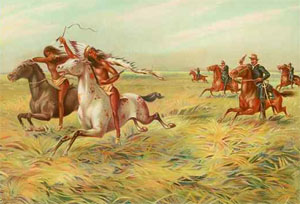
    Fun facts Puritans- Image of  Indian Wars
    Fun facts Puritans- Image of Indian Wars

    Fun Facts

    • In 1675 and 1676, the Wampanoag leader, Metacom, (called King Philip by the colonists) formed an alliance with other tribes to fight the Puritans.

    • The Indians burned 12 villages near Providence and Boston.

    • In 1676, the Mohawks joined with the Puritans. The Puritans killed Metacom and carried his head on a stick. His wife and son were sold as slaves.

    • The war was over: two thousand colonists and four thousand Indians had been killed.

    • In the 1750s, the French and English were fighting for control of North America. The Algonquin Indians, allies with the French, often attacked British settlements to help the French.

    • In 1754, the British engaged in a battle with the French and Indian tribes, who fought from the cover of trees. Over half the British soldiers were killed. George Washington realized that the troops must change their tactic of fighting in formation in open fields.

    • In 1756, England formally declared war on France. William Pitt, leader of Parliament, focused Britain’s military focus on defeating the French in North America. The Iroquois tribes, the colonists, and the British military worked together, attacking Fort Niagara and Lake Champlain. In 1763, gave up all claims to North America.

    Vocabulary

    1. Sought: attempt, try

    2. Godless: uncivilized, without religion

    3. Coexistence: living or existing together

    Questions and Answers

    Question: Did the wars between the Indians and the colonists end after the Revolutionary War?

    Answer: No. Conflicts over land ownership continued until the mid-1800s.

    Learn More

    Visit the U.S. Department of State to learn more about the French and Indian War.
    Religious Tolerance

    The Puritans who developed the Massachusetts Bay Colony followed their religion strictly. Although they came to America seeking freedom to worship their religion, they didn’t always give that freedom to others. Several people were banished from the Puritan community because they expressed their own ideas about religion.

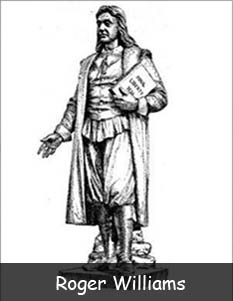
    Fun Facts of Religious Tolerance- Image of Roger Williams
    Fun Facts of Religious Tolerance- Image of Roger Williams

    Fun Facts

    •  Anne Hutchinson was an outspoken woman who disagreed with some of the preacher’s sermons. Over 80 people visited her home weekly to discuss religion. The community leaders thought she was dangerous. They arrested her and charged her with heresy. She was banished from the Massachusetts Bay Colony in 1636.
    • Roger Williams was a minister. He recognized the danger of any one religion having too much power. He thought America should be a country where people could worship however they chose. He also thought the practice of taking land from the native tribes was wrong. Others disagreed with him and he was also banished in 1636.
    • Williams purchased land from the Narragansett Indians. This land became what we now know as Rhode Island. Rhode Island was a refuge of religious freedom. People came here from other parts of New England.
    • Early American leaders learned lessons from the Puritans. Thomas Jefferson read Roger Williams’ ideas about separation of church and state. These ideas helped form the First Amendment, which guarantees religious freedom.

    Vocabulary

    1. Banish: to force someone to leave and not come back
    2. Outspoken: to speak one’s mind directly and often without caring about the consequences
    3. Heresy: a belief that goes against accepted religious views

    Frequently Asked Questions

    Question: Have people in America been persecuted for religious beliefs since then?

    Answer: Although we now have laws protecting religious freedom, people don’t always obey these laws. In the 1800s, hundreds of Mormons were driven from their homes or even killed because of their religion. After September 11, 2001, Muslims were targeted because of their beliefs. Jews, Jehovah Witnesses, and others have been bullied or persecuted. Think about how you feel about religious freedom. How can you be respectful of others’ views even if you don’t agree with them?

    Learn More

    Visit Scholastic to learn more about our basic rights.

    In Search of Religious Freedom: Puritans and Pilgrims

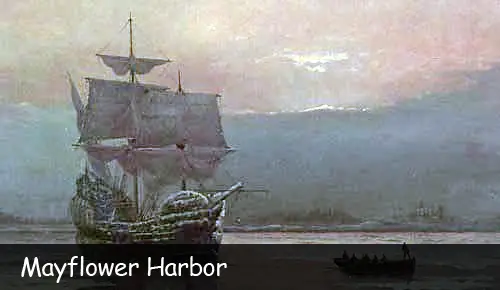
    Imagine leaving your home and setting out for a new, largely unknown world. Imagine taking only a few clothes and tools – no toys, no books, and certainly no video games. Now imagine traveling in the belly of a small boat with 100 other people. There is no privacy and only a small pot to use as a toilet! You are seasick most of the voyage, but when you feel well enough to eat, you eat plain food, such as hard biscuits, dried fish, or unsweetened oatmeal. Welcome to life aboard the Mayflower!

    In 1620, 102 Pilgrims sailed to the New World on the Mayflower. They were seeking a place to worship God as they wanted. Most of them paid dearly for their beliefs, not surviving the first winter. 

    Fun facts of Puritans and Pilgrims- Image of Mayflower
    Fun facts of Puritans and Pilgrims- Image of Mayflower

    Fun Facts

    • The Mayflower was a merchant ship, designed to transport goods. It wasn’t really meant for passengers and was hardly comfortable. It was 90 feet long, large by the day’s standards, but very crowded.
    • The Pilgrims didn’t agree with the teachings of the Catholic Church or the Church of England. They wanted to follow the Bible’s teachings more closely. They were called Separatists and were persecuted by political and religious leaders in England.
    • The Pilgrims originally planned to sail to Virginia but their ship was blown off course. They landed in Plymouth, Massachusetts. They decided to make their own laws, called the Mayflower Compact.
    •  The Pilgrims landed in America on November 11, 1620. The trip had taken 66 days.
    • One passenger, William Butten, died on the voyage. One child, Oceanus Hopkins, was born.
    • The Pilgrims landed in Massachusetts in the winter. They were already weak and sick from the trip. Finding food and building homes was very difficult. Of the 102 passengers, only 51 survived the first winter.
    • Friendly Wampanoag Indians taught the Pilgrims how to grow corn, squash, beans, and pumpkins. Without their help, the Pilgrims probably wouldn’t have succeeded in building their colony.
    • John Carver was the first governor of the colony. He died in 1621.

    Vocabulary

    1. Privacy: to be alone or undisturbed by other people
    2. Merchant:  someone in the business of trading or selling goods
    3. Persecute:  to cause emotional or physical harm to others because of their beliefs

    Questions and Answers

    Question: What did the Pilgrims do to entertain themselves on the Mayflower?

    Answer: The Pilgrims sometimes walked above deck during calm weather, but they generally remained in the cramped quarters below. They were often sick from being tossed in the ocean’s waves and were sometimes thrown against the walls in stormy weather. They probably talked quietly or played games. John Howland, a servant to John Carver, was thrown into the sea during a storm. He grabbed a rope trailing in the water and crew pulled him aboard. Lucky thing, since more than 2 million Americans are descended from him, including George Bush, George W. Bush, Ralph Waldo Emerson, Henry Wadsworth Longfellow, and Mormon leader, Joseph Smith.

    Learn More

    Visit Scholastic for an interactive tour of the Mayflower and life in New England.