
Massasoit and his men taught the Puritans how to grow crops in the New World and generally enjoyed good relationships with these new settlers. But in most areas, the colonists and Indians maintained an uneasy coexistence. The colonists brought disease to the Indians and took their land. Colonists often saw the Indians as godless and uncivilized. They sought to convert the natives and change their culture.
Fun Facts
-
In 1675 and 1676, the Wampanoag leader, Metacom, (called King Philip by the colonists) formed an alliance with other tribes to fight the Puritans.
-
The Indians burned 12 villages near Providence and Boston.
-
In 1676, the Mohawks joined with the Puritans. The Puritans killed Metacom and carried his head on a stick. His wife and son were sold as slaves.
-
The war was over: two thousand colonists and four thousand Indians had been killed.
-
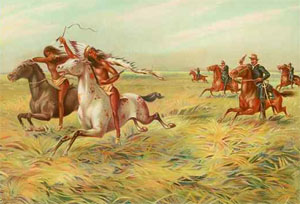
In the 1750s, the French and English were fighting for control of North America. The Algonquin Indians, allies with the French, often attacked British settlements to help the French.
-
In 1754, the British engaged in a battle with the French and Indian tribes, who fought from the cover of trees. Over half the British soldiers were killed. George Washington realized that the troops must change their tactic of fighting in formation in open fields.
-
In 1756, England formally declared war on France. William Pitt, leader of Parliament, focused Britain’s military focus on defeating the French in North America. The Iroquois tribes, the colonists, and the British military worked together, attacking Fort Niagara and Lake Champlain. In 1763, gave up all claims to North America.
Vocabulary
1. Sought: attempt, try
2. Godless: uncivilized, without religion
3. Coexistence: living or existing together
Questions and Answers
Question: Did the wars between the Indians and the colonists end after the Revolutionary War?
Answer: No. Conflicts over land ownership continued until the mid-1800s.
Learn More
Visit the U.S. Department of State to learn more about the French and Indian War.
