• Tag Archives: The Civil War

    The Gettysburg Address

    In November of 1863, President Lincoln came to Gettysburg, Pennsylvania to dedicate the Gettysburg War Cemetery, the site of one of the bloodiest battles of the Civil War. As he came to Gettysburg on the train, he wrote a simple speech. This speech was only about four minutes long. Many people in the audience didn’t even know he had given it until they read about it in the newspaper the next day.
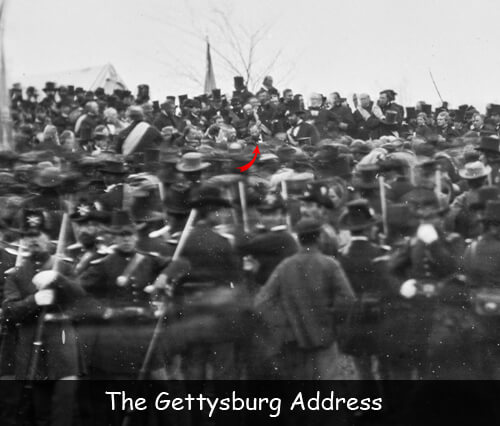
    The-Gettysburg-Address

    But Abraham Lincoln’s speech is remembered as one of the most eloquent speeches ever delivered by an American President. Abraham Lincoln was a deeply religious, patriotic man. He believed that the Civil War was a punishment from God to both the North and South for their sins. He also believed that democracy was a fragile, precious thing, easily destroyed but worth protecting.

    The Gettysburg Address

    Four score and seven years ago our fathers brought forth on this continent, a new nation, conceived in Liberty, and dedicated to the proposition that all men are created equal.

    Now we are engaged in a great civil war, testing whether that nation, or any nation so conceived and so dedicated, can long endure. We are met on a great battle-field of that war. We have come to dedicate a portion of that field, as a final resting place for those who here gave their lives that that nation might live. It is altogether fitting and proper that we should do this.

    But, in a larger sense, we can not dedicate — we can not consecrate — we can not hallow — this ground. The brave men, living and dead, who struggled here, have consecrated it, far above our poor power to add or detract. The world will little note, nor long remember what we say here, but it can never forget what they did here. It is for us the living, rather, to be dedicated here to the unfinished work which they who fought here have thus far so nobly advanced. It is rather for us to be here dedicated to the great task remaining before us — that from these honored dead we take increased devotion to that cause for which they gave the last full measure of devotion — that we here highly resolve that these dead shall not have died in vain — that this nation, under God, shall have a new birth of freedom — and that government of the people, by the people, for the people, shall not perish from the earth.

    Vocabulary

    1. Four score and seven years ago: A score is 20 years; Four score and seven years ago means 87 years ago, which refers to the Revolutionary War and America’s independence.
    2. Consecrate: to set aside as holy
    3. Hallow: holy, of God

    Questions and Answers

    Question: Do all American presidents write their own speeches?

    Answer: U.S. Presidents generally have speech writers to write their speeches although they may give ideas and directions about what should be in a speech.

    Learn More

    Did you know that Abraham Lincoln is often credited for our modern Thanksgiving celebration? Visit the American Presidency Project to learn more.
     

    How the Civil War Was Fought

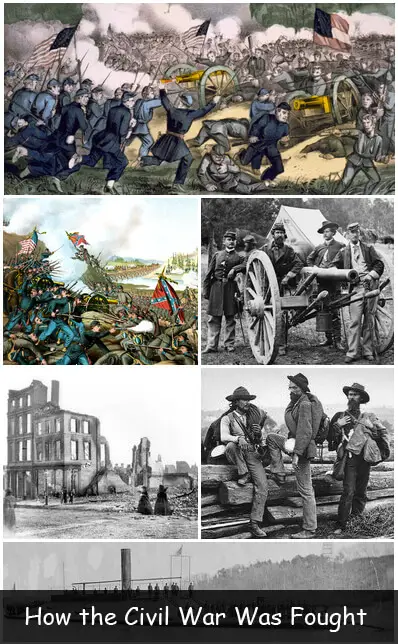
    The Civil War killed more men than all other U.S. wars combined – over 600,000 soldiers. New technologies such as the telegram and railway made communication and the delivery of supplies and weapons more efficient. The weapons themselves were more powerful, more accurate, and more lethal.

    How-the-Civil-War-Was-Fought

    Fun Facts

    • Although the Civil War was a “modern war,” soldiers still believed in gentleman’s warfare. Probably in part because they were fighting against their own countrymen, opposing troops often showed kindness to each other – delivering the letters of a dying soldier to his family or trading tobacco and coffee.
    • In previous wars, soldiers marched in straight lines with muskets and bayonets, firing at the enemy when ordered. New weapons changed the slow, plodding pace of war. These weapons were faster to load and more accurate. General Lee’s troops built trenches to protect themselves. Trenches were used extensively in World War I and II.
    • During the Revolutionary War, communication had to be delivered in person and was often delayed by days or weeks. The invention of the telegraph in 1840 meant that war communication was almost instant. Military leaders could instantly send messages about strategies or supplies.
    • At least one-third to one-half of those who died in the Civil War died from disease and infection caused by poor medical care. Doctors hadn’t yet learned that disease was spread by germs. Injured soldiers were treated in field hospitals where doctors used dirty tools and needles.
    • The camera was a new invention during the Civil War. For the first time, photographers and journalists followed troops. Newspapers published graphic battle stories and photographs.

    Vocabulary

    1. Telegraph: a machine that transmits messages along wires through signals.
    2. Infection: a disease caused by a virus or bacteria

    Questions and Answers

    Question: What were slaves doing during the war?

    Answer: Abraham Lincoln issued the Emancipation Proclamation in January, 1863, which officially freed all slaves. Because the Southern states had seceded and no longer considered themselves under the authority of the U.S., Lincoln had no real power to free the slaves.

    However, after Lincoln’s proclamation, many free blacks, as well as runaway slaves enlisted in the Union army. Unfortunately, they were often discriminated against. They served in all-black units lead by white officers and were often paid less than white soldiers.

    Learn More

    Learn more about the Emancipation Proclamation and the role of black soldiers in the Civil War.

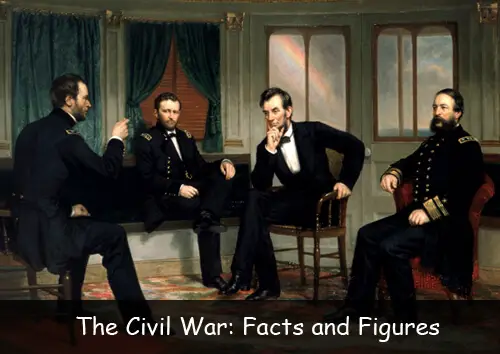
    The Civil War: Facts and Figures

    The Civil War lasted four years. At its end, over 600,000 soldiers were dead. Much of the South lay in ruins. Yet, the Union had been saved and the practice of slavery abolished.

    The-Civil-War-Facts-and-Figures

    Fun Facts

    • On July 20, 1861, Union troops moved toward the Confederate capital of Richmond, Virginia, just 20 miles from Washington D.C. They met Confederate troops at Bull Run, a small river. The Union troops were unprepared and were chased back to Washington.
    • Later that year, Northern troops again tried to take Richmond but were soundly defeated by General Lee’s defenses.
    • The South seemed to be winning the war as Lincoln struggled with weak military leaders. In 1862, Ulysses S. Grant captured Forts Henry and Donelson, giving the North her first victories. Lincoln later appointed Grant as Lieutenant General of the Union army – a move that proved wise.
    • July 1, 1863 was a terrible day for both sides. General Lee hoped that by invading Pennsylvania, he would convince the North to end the war. 51,000 men died at Gettysburg, Pennsylvania in a battle that lasted three days. When it was over, Lee led what was left of his troops back to Virginia. Behind him, a wagon train carrying the wounded stretched for 14 miles. General Lee was so discouraged that he tried to resign. Jefferson Davis, President of the Confederacy refused to accept Lee’s resignation.
    • The Battle of Gettysburg weakened the Confederate army. General Lee’s only hope was to keep fighting until the Union army became weary of war.
    • General Grant realized that he would need to completely destroy Lee’s army to end the war. He and General Sherman coined a strategy, “Total War,” which meant not only a fight against Confederate troops, but a war against Southern civilians. General Sherman’s troops marched to Atlanta in September, 1864. They destroyed everything in their path and burned the city.
    • On April 9, 1865, General Lee met with Ulysses S. Grant to offer his surrender. A few weeks later, General Joseph E. Johnston issued his surrender to General Sherman. The war was over!

    Vocabulary

    1. Resign: to voluntarily leave or quit a position
    2. Weary: deeply tired

    Questions and Answers

    Question:

    Learn More

    Visit Scholastic to learn more about the Civil War.

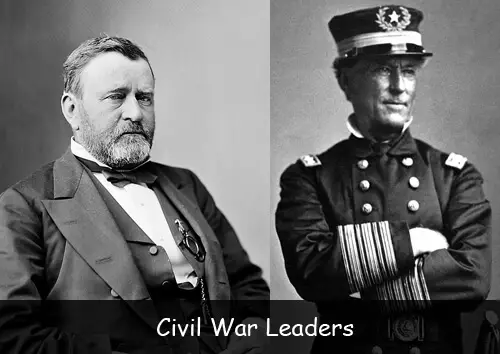
    Civil War Leaders

    The Civil War was often called the “Brother’s War” because it pitted states, towns, villages, and even families against each other. For example, Abraham Lincoln’s wife, Mary Todd Lincoln, had three brothers who fought for the Confederacy and were killed.

    Civil-War-Leaders

    Many of the soldiers and officers for both sides had attended West Point or other military schools. They felt torn between their loyalty to the Union and their loyalty to their families or communities.

    Fun Facts

    • Abraham Lincoln, a poor farm boy from Kentucky, grew up to become a lawyer, and later the President of the United States during the Civil War. Although he hated slavery, he believed the Constitution didn’t give him power to do away with slavery.
    • Jefferson Davis had served as a senator, congressman and U.S. secretary of war. He didn’t want the South to secede from the Union, but accepted the position of President of the Confederacy when asked.
    • Ulysses S. Grant became Lincoln’s right-hand man and commander of the Union armies. He was slow and methodical in his strategy. Critics called him “Butcher Grant,” believing he deliberately forced troops into deadly situations in his effort to bring an end to the Civil War.
    • Robert E. Lee was an officer in the U.S. army who hated slavery and opposed secession. President Lincoln asked him to lead the Union troops but he declined and became the commander of the Confederate army instead. He said that he could not be disloyal to his birthplace, home, and children. Lee was a sly and clever military strategist.
    • William Sherman was born in Ohio and oversaw a Louisiana military school. Yet, when the Civil War began, he enlisted in the Union army. He suffered from depression during the early days of the war, but later became one of Grant’s best leaders.
    • Stonewall Jackson grew up in Virginia and became a courageous, honorable leader for the Confederacy. During the first battle, an officer commented on Jackson, standing firm and strong like a “stone wall,” which is where he got his nickname.

    Vocabulary

    1. Secede: to withdraw or leave
    2. Oppose: to be against
    3. Methodical: thoughtful, analytical

    Questions and Answers

    Question: What happened to Civil War leaders after the war?

    Answer: Abraham Lincoln was assassinated just five days after the Civil War ended; Ulysses S. Grant went on to became U.S. President.

    General Robert E. Lee was pardoned by Lincoln for his role in the Civil War, but his life wasn’t easy. His estate in Arlington, Virginia became the site of a cemetery for Union soldiers. He took a low-paying, obscure job as president of Washington College. He felt deeply wounded by the part he had played in the divisive and bloody war. In 1865, he signed an oath, asking to become an American citizen again. He did this partly for himself and partly as an example to other Confederate soldiers. He wanted to restore peace to his country. Unfortunately, the oath was misplaced and he died without regaining his citizenship. The oath was discovered 100 years later in the National Archives. In 1975, President Ford declared General Lee a citizen once again.

    Stonewall Jackson died in 1863 from pneumonia, after being accidentally shot by his own troops. William Sherman became the general of the U.S. Army. He later retired and led a quiet life.

    Visit Civil War Trust to watch a video about the Civil War leaders.

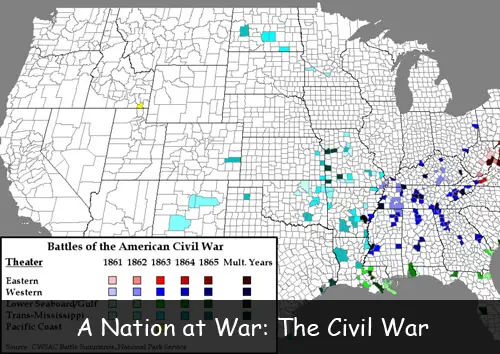
    A Nation at War: The Civil War

    Trouble between the North and the South over the issue of slavery had been brewing for over 50 years, but finally exploded in 1860 when Abraham Lincoln was elected President. Seven Southern states left the Union, forming a new country.

    A-Nation-at-War-The-Civil-War

    Fort Sumter, a fort controlled by the Union, sat on an island in the Charleston, South Carolina harbor. When soldiers here asked the federal government to send more men and supplies, Confederate militia decided that the fort was a threat. Confederate militia opened fire on the fort. The next day, the Federal soldiers surrendered and left the fort. The Confederates took the fort. No men were killed in the skirmish, but the Civil War had begun!

    Fun Facts

    • In 1860, the Republican party chose Abraham Lincoln as their presidential candidate. Abraham Lincoln was against allowing slavery to expand into new territories, but also wanted to keep the Union intact. His campaign focused on building a railroad across the country, as well as a homestead law that would encourage settlers to buy and farm land. The Democratic party was in conflict. Northern Democrats wanted Stephen Douglas, who thought states should be allowed to choose whether to allow slavery, as their candidate. Southern Democrats wanted pro-slavery candidate John C. Breckinridge. Abraham Lincoln narrowly won the election.
    • Southern states had warned that they would leave the Union (secede) if an anti-slavery President was elected. Most Northerners thought they were bluffing. But in December, 1860, shortly after Lincoln was elected President, lawmakers in South Carolina unanimously voted to secede. Alabama, Florida, Georgia, Louisiana, Mississippi, and Texas soon left too. These states formed the Confederate States of America. They elected Jefferson Davis as president and even wrote a new constitution and created a new flag.
    • Not all Southern states seceded. Delaware voted unanimously to stay in the Union. Kentucky, Maryland, Missouri were fiercely divided. In Virginia, six western counties broke off from the state to form West Virginia, a Union state, while Virginia became a Confederate border state.

    Vocabulary

    1. Militia: a military group; troops
    2. Skirmish: small fight
    3. Secede: leave

    Learn More

    Visit Scholastic to learn more about the Civil War.


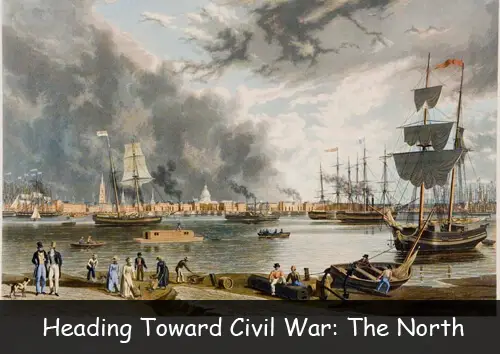
    Heading Toward Civil War: The North

    Even before the Revolutionary War, the North and South had cultural and geographical differences. As the years went on, these differences became larger. From the 1820s to the 1850s, bustling cities sprang up in the North. Workers came to these cities to work in factories making cloth, furniture, watches, tools, and other items.

    Heading-Toward-Civil-War-The-North

    Many people in the North opposed slavery. By the end of the 1700s, slavery was illegal in most Northern states. Over 250,000 free black people lived in the North. Some of them had been born free or given their freedom. Others had bought their freedom or escaped from the South.

    Fun Facts

    • Men became wealthy building factories and railroads. Most of the railroads built during this time were built in the North, which gave the North an advantage over the South. Factories in the North could ship their goods to people living in the West and Midwest.
    • Factory workers – many of them, young women – came from farms to the cities. Initially, many factory owners took good care of their employees, offering them safe, clean housing and education. Company owners became greedy though and wanted to keep their profits. Factory workers often worked long hours in unclean and unsafe conditions.
    • In Ireland, a potato famine caused widespread suffering and death. Thousands of people immigrated to the U.S. from Ireland and Germany. These people were desperate for work and accepted the low wages and poor conditions found in the factories. If someone complained, they were fired.
    • Abolitionists passionately wanted to end slavery. Abolitionist and writer, Harriet Beecher Stowe, wrote Uncle Tom’s Cabin, a novel that depicted life for Southern slaves. The book sold 300,000 copies in just a few months and motivated Northerners to fight more vocally for an end to slavery.

    Vocabulary

    1. Oppose: to fight against or disagree
    2. Abolition: movement to end slavery
    3. Immigrate: to permanently leave one’s country to live somewhere else

    Questions and Answers

    Question: Did white people welcome free blacks to the North?

    Answer: Some did, even going so far as to offer safety and shelter to slaves escaping from the South. But blacks were often discriminated against in the North. They created their own neighborhoods, schools, businesses, and churches where they would be safe.

    Learn More

    Visit the Civil War Trust to learn more about the differences between the North and the South.