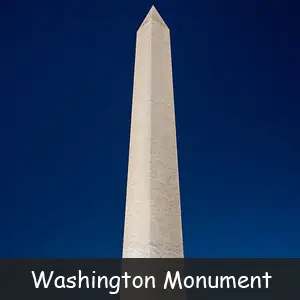
George Washington was the Continental army’s Commander in Chief during the Revolutionary War and he was also the first President of the United States. Known for his unfailing honesty and integrity, he was beloved by almost everyone and is still considered one of our best leaders. After the Revolutionary War, Congress wanted to honor Washington, often called the Father of His Country, with a memorial statue of him astride a horse.
Unfortunately, no money was available to build the statue and George Washington’s memorial was largely forgotten. In 1836, the Washington National Monument Society held a contest for a design for the memorial. Architect Robert Mills won the contest and construction soon began. Work began over 10 years later, in 1848, but halted in 1854 when money ran out once again. Cows grazed around the monument during the Civil War.
Famous American Monuments – Image of Washington Monument
Finally, in 1876, the work began and was completed in 1884 – almost 40 years after it was started. The monument is a simple, white structure rising 555 feet 5 1/8 inches tall. Visitors can take an elevator to the top. The Washington Monument stands at the western end of the National Mall in Washington D.C.
Vocabulary
Commander in Chief: the top leader, usually in a military or governmental organization
Astride: having a leg on each side
Graze: to feed on grass
Questions and Answers
Question: Was Washington sad that no one built him a statue while he was alive?
Answer: Washington was a simple man with a deep love for his country. When he became President, he refused to fund the project because he didn’t think it was important. He felt that public funds should be used to serve the people.
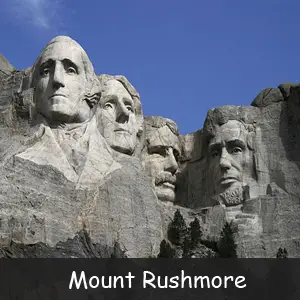
Mount Rushmore, which is found in the Black Hills of South Dakota, was once just a towering granite cliff. In 1924, Doane Robinson, secretary of the South Dakota Historical Society, suggested carving famous Wild West figures out of the mountain to draw tourists to the area. Sculptor John Gutzon de la Mothe Borglum was hired for the job. In the end, Borglum sculpted George Washington, Thomas Jefferson, Abraham Lincoln, and Theodore Roosevelt instead. The project took fourteen years to complete. Millions of people still visit Mount Rushmore every year to pay tribute to four of our most influential presidents.
Famous American Monuments – Image of Mount Rushmore
To learn more, head over to PBS Learning Media and join Wilson and Ditch in South Dakota.
The Capitol
During the Revolutionary War, the Continental Congress met in Philadelphia. After the war, the capitol was moved to Washington D.C. In 1791, President George Washington chose a site for the new capitol building, now known as Capitol Hill.
Work on the new capitol building began on September 18, 1793. The trowel George Washington used to lay the cornerstone for the capitol was also used to lay the cornerstone for the Washington Memorial. Work on the building was slow. In 1814, the building was set ablaze as British armies marched on Washington D.C. A rainstorm doused the flames before the building was completely ruined. Construction continued after the war, and finally, in 1829 the building was complete.
Congress soon outgrew the building and new construction began to enlarge it. During the Civil War, the Capitol served as a hospital, bakery, and army barracks. Construction was finally completed in 1870.
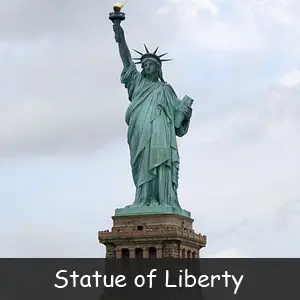
The Statue of Liberty has long been a symbol of freedom and hope to people all over the world, but have you ever wondered where she came from? France has often been called “America’s oldest ally.” France helped America during the Revolutionary War and the War of 1812. American troops helped defend France during World War I and II. The French built “Lady Liberty” as a gift to America.
Famous American Monuments – Image of Statue of Liberty
Poet Emma Lazarus wrote the poem, “The New Colossus,” about America and the Statue of Liberty:
Give me your tired, your poor;
Your huddled masses yearning to breathe free,
The wretched refuse of your teeming shore.
Send these, the homeless, tempest-tost, to me,
I lift my lamp beside the golden door!
Fun Facts
In 1865, at a dinner party in France, French leaders were talking about the Civil War and Abraham Lincoln’s death. They wanted to make a monument to honor America’s fight for liberty. The sculptor, Frederic-Auguste Bartholdi, attended the dinner party. He began working on a small clay model of a woman to represent freedom. He presented it to French and American leaders.
Although the French had hoped to present the statue to America on the 100th anniversary of the signing of the Declaration of Independence, the Statue of Liberty took 10 years to build.
Bartholdi began working on the statue in 1876, in a studio in Paris. He modeled the statue’s face after his mother’s. Jeanne-Emilie Baheux de Puysieux, who later became his wife, also served as a model.
The statue was 111 feet tall – as tall as a fourteen-story building. It needed to be light, yet strong. Engineer, Alexandre-Gustave Eiffel, who engineered the Eiffel Tower, designed an iron framework for the statue. Thin sheets of copper were laid over the framework.
The statue was built outdoors, disassembled, and packed in 214 boxes before it was shipped to America.
The French agreed to pay for the statue; Americans would pay for the land and granite pedestal that the statue stands on. Both countries asked for donations from their people.
On October 28, 1886, President Grover Cleveland prepared to dedicate the statue. Thousands of people gathered in New York City for a huge parade. On Liberty Island, a smaller crowd gathered for the dedication. A French flag lay over the statue’s eyes and face. Inside the crown, stood Bartholdi, ready to pull the flag off at the right time, unveiling the statue.
William M. Evarts, President of the American Committee, began his speech. He paused briefly, and Bartholdi was given the sign to unveil the statue. The crowd cheered when the statue was revealed; Evarts didn’t get the chance to finish his speech!
Frequently Asked Questions
Question: Did women attend the dedication?
Answer: At this time, women weren’t always allowed at public gatherings. Only two or three women were invited to the dedication. But a group of angry women rented a boat and sailed to the island. They said that the statue was a woman, yet if she was alive, she wouldn’t be allowed to vote or have many other liberties.
The War of 1812 between the Americans and British lasted for three years. Only a few weeks after the British burned Washington D.C., destroying the Capitol, the President’s House, and the Treasury, they headed toward Baltimore. The only thing that stood in their way was Fort McHenry, which lay on an island in the Chesapeake Bay.
On September 13, 1814, the fort was attacked by sixteen British ships. It seemed likely that the British would be victorious. Major George Armistead, commander of the fort, wasn’t going to give up without a fight, which went on throughout the night. The British lobbed 200-pound bombshells at the fort. The bombshells often went off in the air and the sky was red and smoky. Would the British win?
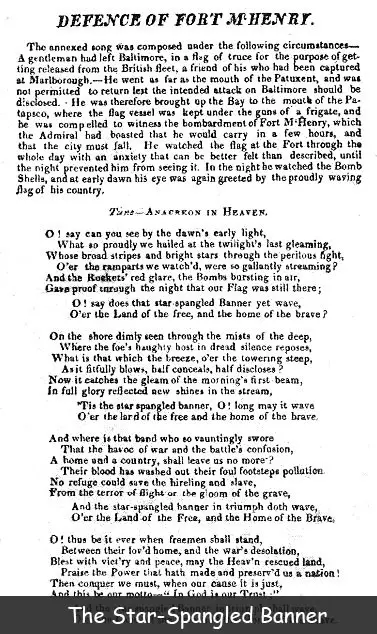
Image of Star Spangled Banner
Fun Facts
Major Armistead knew that Fort McHenry would probably be a target for the British navy. He requested a flag be made to fly over the fort. He wanted the flag to be huge – big enough for the British to see from miles away.
Mary Young Pickersgill, a widowed flagmaker, was hired to sew the flag. With the help of several family members, she completed the flag in six weeks. The flag measured 42 feet long by 30 feet high – the size of a very, very large room. Each stripe was two feet wide and the stars measured two feet from point to point. Mary used 300 yards of English wool bunting cloth to make the flag. She was paid $405.90 for her work.
A few days before the attack, a young American lawyer, Francis Scott Key, boarded a British ship to negotiate the release of an elderly doctor. The British agreed, but kept Francis and the doctor under guard so they couldn’t warn the Americans of the impending attack.
All through the night of the attack, Francis stood aboard a ship, watching the attack on the fort. At times, it was hard to see clearly through the smoke, but it was very noisy. He knew that as long as he heard noise, the fighting continued and the fort hadn’t surrendered.
At dawn, the fighting stopped. Francis was afraid that the British had won. As the sun came up and the smoke cleared, he saw the American flag – the huge American flag – still waving proudly. He was overcome with happiness.
That night in his hotel room, Francis wrote a poem to express how he felt. A few days later, the poem was published in a Baltimore newspaper, along with instructions to sing it to the tune of “Anacreon in Heaven,” a well-known song at the time. People loved the song!
In 1916, President Woodrow Wilson decreed that the song, now known as, ”The Star Spangled Banner” be played at all state occasions. In 1931, it became our national anthem.
Frequently Asked Questions
Question: What happened to the flag that Mary worked so hard to make?
Answer: The Armistead family owned it for many years. Sometimes they cut pieces off the flag to give to family members or honored soldiers. Eventually the flag was donated to the Smithsonian. The flag has recently undergone a renovation. The entire flag can be seen at the Smithsonian Museum.
Learn More
Visit an online exhibit of the Star-Spangled Banner. Here, you’ll find pictures, games, and interesting facts about the flag.
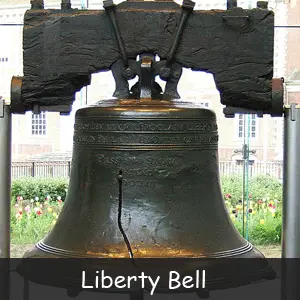
Sometimes ordinary objects become special over time. The Liberty Bell is just such an object. The Liberty Bell began its life as an ordinary bell, ordered from London, to ring at the Pennsylvania State House in Philadelphia. Everyone was excited when the bell was delivered to the State House in 1751. But when the bell was rung, it made a terrible sound and a wide crack appeared in its side. So, how did this bell get to become a patriotic symbol?
Famous American Monuments – Image of Liberty_Bell
Fun Facts
After the bell cracked, John Pass and John Stow offered to fix it. They used sledgehammers to break the bell into pieces. Then they melted it and recast it, adding some copper to strengthen it.
The bell was completed in 1753, but when it was rung, it had a harsh, dull tone. The people were disappointed again. Pass and Stowe were determined to fix it. They took the bell down, melted it once more, and added some tin. The new bell sounded better, but still didn’t have the beautiful tone the people had hoped for.
On July 8, 1776, Congress read the newly signed Declaration of Independence to the people. Imagine their joy as they heard the words, “All men are created equal.”
The bell rang out after the reading of the Declaration. On the bottom of the bell was written the words, ‘Proclaim Liberty Throughout All the Land Unto All the Inhabitants Thereof,” a phrase which comes from the Bible. The bell suddenly seemed more important and special.
During the Revolutionary War, the bell was hidden from the British under the floor of a church. After the British left Philadelphia, the bell was retrieved. It rang when Britain surrendered York Town and when the peace treaty was signed in 1783.
After the war, the bell was only used for special occasions. It was rung in 1835 at the death of Supreme Court Chief Justice John Marshall’s death. Unfortunately, it cracked once again. A new bell was ordered and the old bell was largely forgotten.
Then in 1846, a newspaper writer suggested the cracked bell be rung to celebrate George Washington’s birthday. Suddenly, the old bell was beloved again. It was named the Liberty Bell.
Since then, the State House in Pennsylvania has been renamed Independence Hall. The bell is now kept in a glass case across the street. It is rung every 4th of July and on special occasions.
Vocabulary
Inhabitants: citizens or people who live in a specific place
Retrieve: bring back
Frequently Asked Questions
Question: How big is the Liberty Bell?
Answer: The bell is 3 feet high. It measures 12 feet in circumference around the base. The bell weighs just over a ton – 2080 pounds.
During Medieval times and even earlier, important people added a seal made of wax to letters and documents. These seals proved that the letter was really written by the person who signed it. Seals were sometimes used to close letters to keep them secret.
Today, seals are still used on official documents. A notary is a government official that has a special seal used to verify documents, such as legal agreements. The Great Seal of the United States is sometimes added to very important documents.
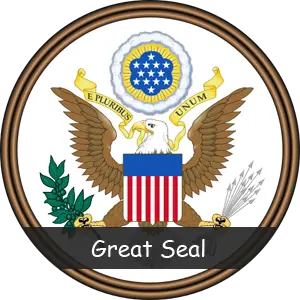
Famous American Monuments – Image of Great Seal
Fun Facts
The Continental Congress began planning a seal as soon as the Declaration of Independence was signed. The Great Seal wasn’t approved by Congress until 1782.
The Great Seal is a round piece of metal with designs on both the front and back. You can see both sides of the Great Seal printed on the back of a dollar bill.
On the front of the seal is bald eagle with the shield of the United States. The shield has thirteen red and white stripes, representing the thirteen original colonies.
The shield is unsupported, symbolizing that America stands on its own for virtue and justice.
A blue stripe at the top of the shield stands for Congress.
The eagle holds an olive branch, symbolizing peace, in one talon.
The other talon holds the arrows of war.
The eagle holds a ribbon in its beak which contains the Latin words, “E. pluribus unum,” which means “From many, one.” (from many states, one nation)
The back of the seal bears a pyramid with thirteen layers, representing the thirteen original colonies.
On the bottom step of the pyramid is the Roman date MDCCLXXVI—1776.
The top of the pyramid is an all-seeing eye, which represents God. Above the eye are the Latin words, Annuitcoeptis, which means “God has favored our undertaking.” Below the pyramid, is inscribed, “Novus ordo seclorum,” which means, “A new order of the ages is created.”
Vocabulary
Shield: a protective device used in battle
Talon: a bird’s claws
Pyramid: triangular-shaped structure
Questions and Answers
Question: Why did the Founding Fathers add so many words and images to the Great Seal?
Answer: They hoped that the Great Seal would inspire future generations and help them remember the Founding Fathers’ love of freedom, virtue, honesty, courage, sacrifice, and belief in God.
Learn More
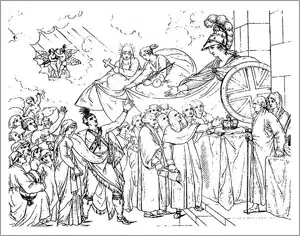
The Founding Fathers quickly drafted some ideas for the Great Seal as soon as the Declaration of Independence was signed. Visit PBS to see one of their first designs.
After the United States became a nation, the Founding Fathers wanted to choose a national emblem. The task was more difficult than they probably expected. Some people suggested the eagle. Benjamin Franklin disagreed because many other countries had previously chosen the eagle as their emblem. Franklin also said that eagles didn’t represent integrity because they steal food from other animals.
Famous American Monuments – Image of Washington Monument
Fun Facts
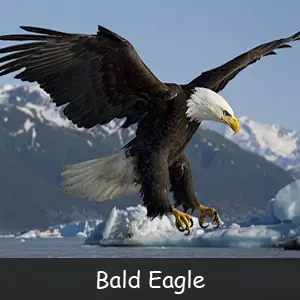
In 1782, the Founding Fathers chose the bald eagle as our national emblem. Bald eagles live only in North America and they represent strength and dignity.
For many years, bald eagles were endangered. In 1783, there were between 25,000 and 75,000 eagles in the U.S. By 1963, only 800 eagles remained. In 1940, Congress passed a law making it illegal to capture or kill a bald eagle. In 1973, Congress banned the use of DDT, a pesticide that was known to kill birds, frogs, and other animals.
Today, the bald eagle has made a comeback. Bald eagles are no longer endangered.
Wild bald eagles live 30 to 35 years. They have a wingspan of up to 7 feet and can fly up to 35 miles per hour.
Fish is a main food source for eagles. They also eat small mammals or even snakes.
Bald eagles mate for life. Both the mother and father incubate the eggs and take care of the chicks.
Vocabulary
Emblem: an object or animal that represents a country, organization, or family
Dignity: a sense of self-respect, nobility, or pride
Endangered: at risk of becoming extinct
Questions and Answers
Question: What emblems have other countries chosen to represent them?
Answer: Many countries have chosen animals or flowers that are special to their country as emblems. Australia’s emblem is the kangaroo; Ireland’s emblem is the shamrock; and India’s emblem is the peaco-ck. You can see our national emblem, the bald eagle, on our money, as well as the Presidential seal.
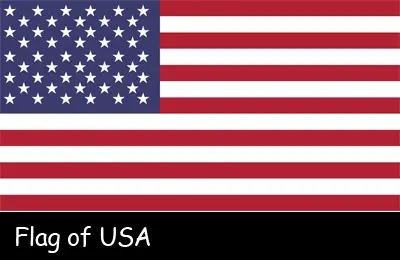
Schools, government buildings, libraries, churches, and even many homes display our flag, especially on patriotic holidays like the 4th of July, but have you ever wondered how we got the flag? “Old Glory” is one of the oldest symbols of our country, but she wasn’t the first flag.
Old Glory, also known as The Stars and Stripes, is a reminder that we are free to work, play, worship, and speak as we wish. We can elect our own leaders, rather than being ruled by a king or queen. The flag is also a reminder of the thousands of people who sacrificed their homes, their time, their money, and even their lives for freedom.
Old Glory – Image for Flag of USA
Fun Facts
The early colonists displayed Union Jack, the British flag, which is blue with a red cross and a white cross. In 1775, the colonists decided to make a new flag. They wanted to express their frustration with British taxes and laws, but they also wanted to show some loyalty to the Crown. The Grand Union flag had red and white stripes. In the upper left-hand corner was a small Union Jack.
In 1777, the colonists decided that they needed a completely new flag. They chose one stripe for each of the thirteen colonies. They added stars to symbolize a new “constellation,” or new government in which people could be free to make their own laws.
The first flags varied. On some flags, the stars were placed in a circle; on other flags, they were scattered or placed in a line.
The story goes that Betsy Ross helped design the first flag. We know that she sewed American flags, but we’re not sure if she designed the very first one.
In 1817, as new states were joining the Union, Congress decided to add a star for each new state. During the Civil War, eleven states left the Union. Some people wanted the stars representing those states to be removed. Abraham Lincoln refused, insisting that those stars remain on the flag. He was determined to reunite the country and he succeeded.
Every day children recite the Pledge of Allegiance, which was written by Francis Bellamy. In 1892, 400 years after Christopher Columbus landed in America, 12 million children pledged allegiance for the first time.
Vocabulary
Allegiance: loyalty
Constellation: a cluster of stars; can also be a group of related things
Reunite: join together again
Questions and Answers
Question: What is the correct way to handle the flag?
Answer: While there is no punishment for mistreating the flag, the National Flag Code, established in 1923, helps us understand how to treat the flag with respect. It says that the flag should never touch the floor or ground. It should fly at night only if it is lit. Only weatherproof flags should fly outdoors in bad weather. The flag should be raised quickly and lowered slowly.
Flags are flown at half-mast as a sign of mourning. Raising a flag upside down indicates distress. The flag is only flown this way in times of dire emergency. A flag is draped over the casket of a soldier or government member. The stars are placed over the top part of the casket, near the person’s heart.
Not everyone was happy when America won its independence from Great Britain. Many people, particularly wealthy slave-owners in the southern states, remained sympathetic to Great Britain. These people were known as Loyalists or Tories. Many black slaves and Native Americans fought for the British, as well.
Fun Facts for Britain – Image for Britain’s Allies
Fun Facts
About one-fifth of the colonists were Loyalists. These included government leaders, such as Governor Thomas Hutchinson and many pastors and priests of the Church of England.
Another one-third of the colonists remained neutral during the war, refusing to take sides.
The Loyalists were hated by the colonists and sometimes experienced mob violence. Over 80,000 Loyalists fled, mostly to Canada.
Benedict Arnold was a brilliant American war hero. Unfortunately, his pride got the better of him. He felt that Congress had failed to appreciate him and made a deal with General Burgoyne to sell the fort, West Point, to the British. The plot was discovered and Arnold was branded a traitor to America. He became a British general, but the British never really trusted him.
Native Americans believed that if the Americans won, they would lose more of their rights and their land, which was true. Many tribes, such as the Cherokee tribe, fought against the Patriots. After the war, all tribes – even those who had fought with the colonists – were displaced from their land and forced further west.
The Declaration of Independence made no mention of freedom for slaves. During the war, the governor of Virginia declared freedom for any slave who would fight for the British. More than 800 slaves took up arms against the colonists and more than 50,000 slaves fled from their owners.
Vocabulary
1. Neutral: to remain without a position or opinion
2. Traitor: one who betrays his country or friends
3. Displace: to uproot
Questions and Answers
Question: Were the Loyalists outspoken about their opinions?
Answer: Some were, especially in the beginning, but many people on both sides quietly supported their causes. Some acted as spies. Those with money offered financial support.
Learn More
Visit PBS to play a game, “The Road to Revolution.”
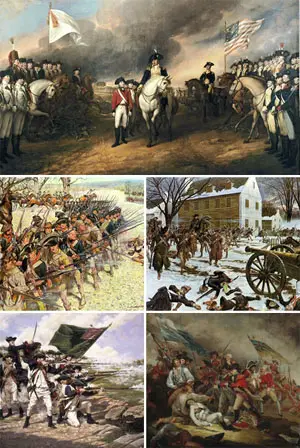
The Revolutionary War began on April 19, 1775 at Lexington and Concord, Massachusetts. It would last six years, ending with General Cornwallis’s surrender in Yorktown, Virginia on October 19, 1781. More than 25,000 Americans died during this war. Considering that Great Britain was one of the most powerful countries in the world at the time, their victory was astounding.
Fun facts of Revolutionary War- Image of Revolutionary War
Fun Facts
George Washington was the leader of The Continental Army. He was a brilliant and inspiring general who eventually led relatively untrained soldiers to victory. Most of the soldiers were farmers or working men. They were promised $60 a year, food, and clothing for enlisting.
The British expected a quick victory. They defeated the rebels at Bunker Hill and captured New York, driving Washington and his men back to New Jersey. They captured Fort Ticonderoga and won battles at Brandywine and Germantown in Pennsylvania.
On December 25, 1776, Washington and his men crossed the icy Delaware River. At dawn, they captured Hessian (German) soldiers at Trenton, New Jersey. The following week, they won again at Princeton. The tide seemed to be turning.
During the summer of 1777, British General John Burgoyne hatched a plan to combine troops with two other forces in New York. If the plan had worked, the war probably would have been over. More than 10,000 American Patriots blocked their path. At the Battle of Saratoga in October of 1777, General Burgoyne surrendered 6,000 men. This was a tremendous victory of the Americans.
Realizing that the Americans had a chance of winning, France jumped in, sending money, supplies, and later troops and ships. France is often called America’s oldest ally. Without their help, the war might have had a very different ending.
The Continental Army spent the winter of 1777-1778 at Valley Forge. Cold, hungry, and sick, almost 25 percent of the army died. During this time, German volunteer, Baron Friedrich von Steuben, trained the soldiers. By spring, they were ready to fight.
In December 1778, General Henry Clinton attacked Charleston, South Carolina. The Americans were badly defeated here and the British controlled much of South Carolina and Georgia.
In the summer of 1781, British General Charles Cornwallis stationed his troops at Yorktown, Virginia where they were waiting for aid from British warships. Washington brought the Continental Army, as well as 5,000 French troops to Yorktown. At the same time, French naval fleets drove off the British ships. The British troops were trapped. Cornwallis surrendered on October 19, 1871. The Americans had won the war.
Vocabulary
1. Enlist: to sign up as a soldier
2. Ally: a friend, partner
3. Surrender: to admit defeat
Questions and Answers
Question: What qualities helped the Americans win?
Answer: The British soldiers marched in straight lines as they charged into battle. The Americans made up their own rules. They hid behind rocks and trees, making it hard for the British to fight them. They knew the terrain well and could live off the land if necessary. Most important, though, was the Patriots’ belief in the ideals of freedom and democracy, which united them, even through hardship.
For example, Nathan Hale, a 21-year-old school teacher, volunteered to be a spy for the Continental Army. The British caught him and hanged him. Before his death, he said, “I regret that I have but one life to give for my country.” Many people shared his deep sense of patriotism and love for America.
Learn More
VisitPBS Learning to watch a video about the Declaration of Independence and the 4th of July.